
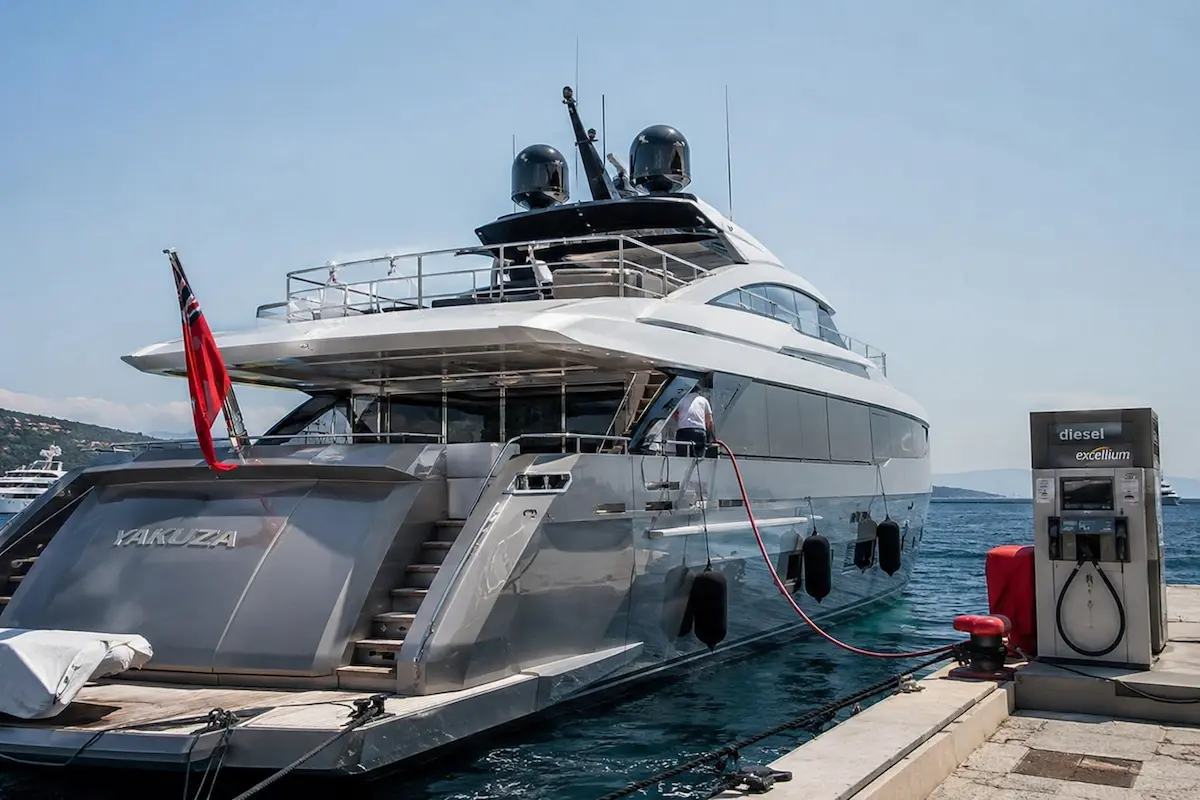
For commercially operated yachts running charters in French waters, diesel does not have to be taxed at the standard pump rate. France provides two separate fuel tax exemptions for qualifying charter vessels:
- TICPE (Taxe Intérieure de Consommation sur les Produits Énergétiques) — the domestic consumption tax embedded in every litre of diesel sold at the pump. In 2025, the national TICPE rate on diesel stands at approximately €0.61 per litre. This is the main saving.
- VAT — the standard 20% value-added tax applied on top of the pre-tax fuel price, including on the TICPE itself. This applies only to vessels that also meet the commercial registration requirement.
To understand what this means in euros: in early 2026, the TICPE alone accounted for around 36% of the pump price of diesel, which stood at approximately €1.70 per litre. Removing the TICPE and then the VAT brings the effective price of blue diesel (gasoil bleu) to roughly €0.85–0.95 per litre — approximately half the standard pump price.
What this means in practice for a charter yacht: a motor yacht of 15–25 metres consuming an average of 100–200 litres per hour underway, operating around 20 navigation days per season (a conservative estimate for a Mediterranean charter programme), burns somewhere between 15,000 and 40,000 litres per year. At a saving of roughly €0.80–0.90 per litre versus the standard pump price, the annual fuel saving from accessing the full exemption ranges from €12,000 to €36,000 depending on vessel size and usage. For larger yachts with higher consumption, the figure is considerably higher.
Sources: TICPE rate from the French Ministry of Finance (2025 Finance Act); pump price reference from FIPECO (February 2026); consumption estimates based on industry benchmarks for 15–25m motor yachts at cruising speed.
How it works
The exemption applies to gasoil bleu (blue diesel) — fuel delivered duty-free directly to the vessel by an authorised supplier. To access it, the yacht must meet a set of cumulative conditions:
| Condition | TICPE exemption | VAT exemption |
|---|---|---|
| Valid charter or transport contract | ✅ | ✅ |
| Permanent crew on board | ✅ | ✅ |
| ≥ 70% of charter legs outside French territorial waters (prior year) | ✅ | ✅ |
| Hull length ≥ 15 metres | ✅ | ✅ |
| Registered as a commercial vessel on an official shipping registry | ❌ not required | ✅ required |
The practical difference: a yacht with a charter contract, permanent crew, and a qualifying navigation record can access the TICPE exemption regardless of its flag or registry type. The additional VAT exemption requires formal commercial registration — typically achieved by flagging the vessel on a commercial registry such as the RIF (French International Register) or an equivalent foreign registry.
The 70% rule — what it actually means
This is the condition that catches most owners off guard. The 70% threshold is not calculated on time at sea or on distance — it is calculated on charter legs. Specifically, on the proportion of commercial legs during which the vessel crossed outside French territorial waters (beyond 12 nautical miles from the French coastline) at least once during that leg.
Each leg is assessed independently: if a single AIS position during that leg places the vessel beyond the 12-mile limit, the leg qualifies. If all positions remain inside French territorial waters, it does not.
What counts as a leg? Under French tax rules (BOI-TVA-CHAMP-30-30-30-10), a charter constitutes a single leg as long as no new passengers embark or disembark mid-contract. Each passenger change at an intermediate stop creates a new leg for the purpose of the calculation.
What does not count? Non-commercial movements — deliveries to shipyards, sea trials, owner’s private use — are excluded from both the numerator and the denominator entirely.
The one-year lag
The 70% ratio is calculated on the prior calendar year (1 January to 31 December). A yacht that qualifies in year N gains access to the exemption from 1 January of year N+1. There is no retroactive recovery for year N.
The exception: a newly commissioned vessel, or one changing owner, may submit a provisional attestation estimating future compliance. If the yacht fails to meet 70% at the end of its first year, all VAT applied under the provisional exemption must be repaid in full.
How to prove it
Proof rests entirely with the operator. Accepted documents include the ship’s log, GPS position records, and AIS track data. AIS traces are in practice the most robust evidence — they are continuous, timestamped, and independently verifiable.
For each qualifying leg, the operator needs to be able to show at least one AIS position recorded beyond 12 nautical miles from the French coast, during the window covered by a valid charter contract.
The operator’s declaration
There is no pre-approval process. The operator signs an attestation (model BOI-LETTRE-000235) under their own responsibility, certifying that all conditions are met, and hands it to their fuel supplier. The supplier then delivers blue diesel at the exempt rate. If a tax audit later reveals that the conditions were not met, the operator — not the supplier — is liable for the full tax amount, plus penalties.
Who actually benefits in practice
A natural question follows from the structure above: the fuel tax exemption is attached to the vessel — so why does a charter client end up saving money on fuel as well?
The mechanism is straightforward, and structurally identical to how every other form of commercial maritime fuel exemption operates. The operator bunkers duty-free, at roughly €0.90 per litre rather than €1.70. That is the cost actually paid for the fuel — recorded on the vessel’s operating accounts at the duty-free rate.
When a charter consumes fuel from those bunkers, the consumption is metered (fuel level at start of charter minus fuel level at end) and invoiced back to the client through the APA (Advance Provisioning Allowance) at the actual cost per litre — i.e., the duty-free price. There is no mechanism in current French law that requires the operator to add back the TICPE or VAT on the portion of fuel attributable to a specific charter. The exemption is binary: qualifying fuel remains exempt regardless of which leg consumes it.
The economic effect is that the duty-free saving flows through the supply chain to the end customer. This is consistent with how commercial fuel exemptions work in every other transport mode: airline passengers do not pay duty on jet fuel attributable to their seat, cruise passengers do not pay duty on bunker attributable to their cabin, ferry passengers do not pay duty on diesel attributable to their fare. The exemption follows the commercial use of the vessel, not the identity or leisure intent of the end consumer.
A note on regulatory direction. This area has been politically active. The VAT treatment of charter income has shifted several times since 2020 following European Commission scrutiny and successive French legislative adjustments. The TICPE framework for charter has not narrowed to date, but operators should not assume the current rules are permanent. Maintaining clean, auditable navigation records — leg by leg, charter by charter — is the most robust position to be in if the framework tightens.
What Scyllastar handles automatically
Calculating the 70% ratio manually across a fleet — cross-referencing AIS logs, charter contracts, leg boundaries, and passenger changes — is exactly the kind of work that falls through the cracks without dedicated tooling.
Scyllastar’s AIS integration logs every position for every vessel, maps each position to the corresponding charter leg, and computes the annual 70% ratio per yacht automatically. At year-end, the system identifies which vessels qualify, generates the full supporting documentation package — AIS traces per leg, ratio summary, and the attestation framework (BOI-LETTRE-000235) — ready to hand directly to your maritime tax advisor or legal counsel for review and sign-off.
One thing to be explicit about: Scyllastar records what actually happened — it does not optimise itineraries to hit a threshold. If a vessel’s real navigation qualifies it, the documentation package is complete and audit-ready. If it does not, the system reflects that too. Operators cannot selectively report qualifying legs without the full annual record being visible — and that is exactly what a tax advisor needs to sign off on a claim with confidence.
That documentation layer matters. Scyllastar produces the data; your advisor validates it. Tax law in this area has moved several times in recent years and the details of how individual situations are assessed can vary. We strongly recommend having a qualified maritime tax specialist review the output before submitting any exemption claim — the numbers Scyllastar produces give them exactly what they need to do that efficiently.
Note: Nothing in this article constitutes tax or legal advice. Scyllastar is a yacht management platform, not a tax authority. Always consult a qualified advisor before making exemption claims.