
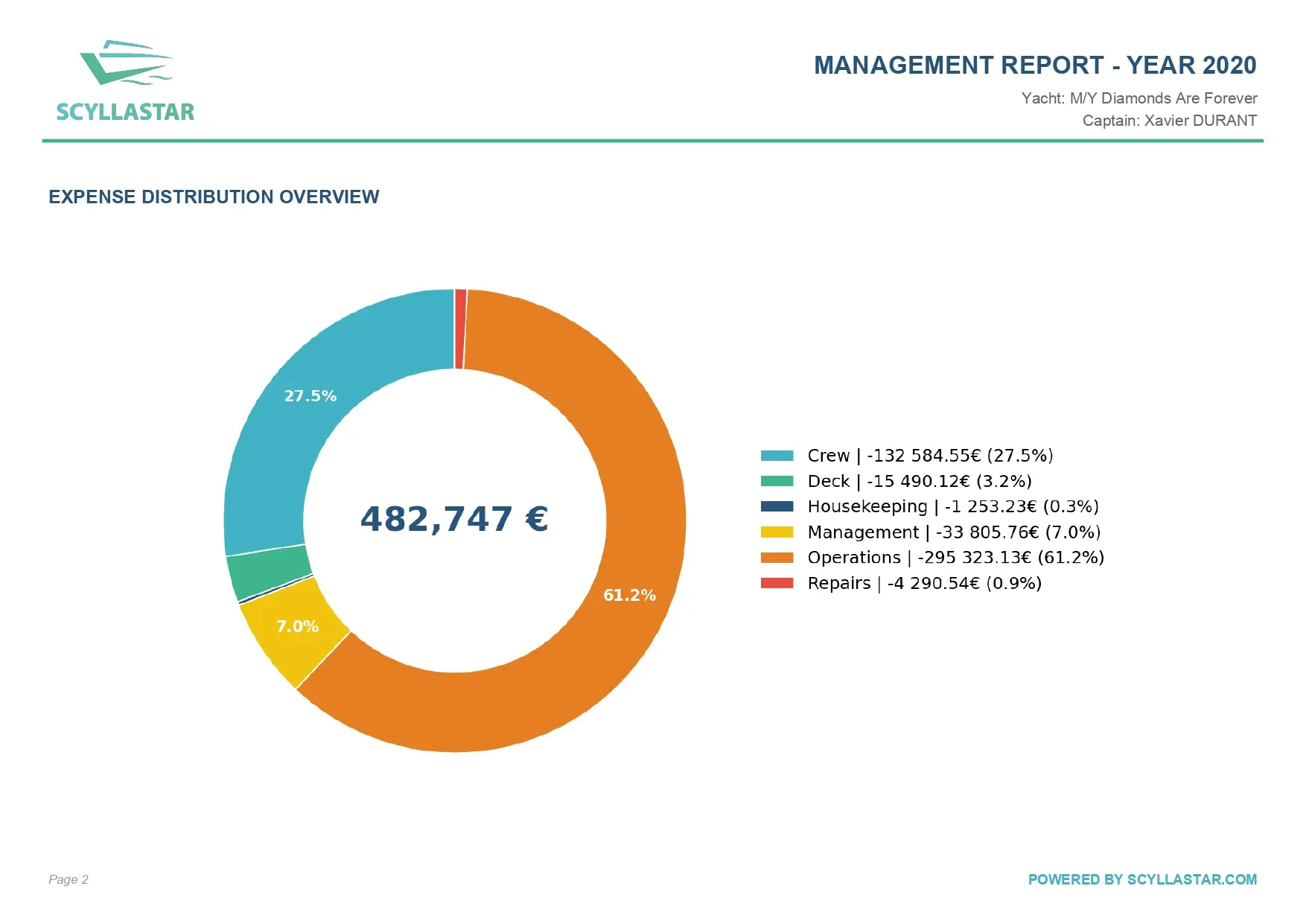
Financial administration for a yacht is the management of everything that happens to the money: budgeting, expense tracking, supplier payments, crew payroll, VAT obligations, bank accounts and the monthly reporting that shows the owner where every euro went.
Financial administration is the least glamorous part of yachting — and the part that decides whether ownership is a controlled cost or a permanent leak. It covers everything that happens to the money: budgeting, expense tracking, supplier payments, crew payroll, VAT obligations, bank account management, and the reporting that tells the owner where every euro went.
This guide explains how financial administration for yachts actually works in practice: who does it, what it costs, which model fits which vessel, and how the requirements change from the day you buy the boat to the day you sell it.
1. What does financial administration for a yacht cover?
Regardless of the size of the vessel or how it is used, yacht financial administration always includes the same building blocks:
- Budgeting — an annual operating budget per category (fuel, crew, maintenance, berthing, insurance, administration), tracked against actuals throughout the year
- Expense tracking — every invoice and receipt collected, categorised and stored, with a clear link to the vessel and, where relevant, to a specific charter
- Supplier payments — shipyards, chandleries, marinas, provisioners, insurers — paid on time, from the right account, with a clean paper trail
- Crew payroll — salaries, social charges, expense reimbursements, and the employment framework that depends on the flag state
- VAT and tax obligations — from simple (private use) to genuinely complex (commercial charter across several countries)
- Bank account management — dedicated vessel accounts, cards, cash floats, and reconciliation
- Owner reporting — the monthly statement that turns thousands of transactions into a picture the owner can actually read
The building blocks are always the same. What changes — dramatically — is the intensity, depending on two questions.
2. Which two questions change everything?
Before choosing who should manage a yacht’s finances or what it should cost, answer these two questions. They determine everything downstream.
Question 1 — Is the yacht under or over 25 metres?
Below roughly 25 metres, most yachts operate without a permanent crew. Transaction volume is modest, payroll may not exist at all, and the administration can realistically be handled by the owner’s accountant or a light management arrangement.
Above 25 metres, the vessel almost always runs a full-time crew. That single fact transforms the administration: monthly payroll across several nationalities, crew expense workflows, rotations and travel, provisioning at scale, and a transaction volume that can reach dozens of entries per week. At this size, financial administration is no longer a side task — it is a permanent function that someone must own.
Question 2 — Is the yacht private or commercial?
This is the bigger fork in the road.
A privately used yacht has no revenue, no VAT to collect, and no tax returns tied to a charter activity. The financial challenge is visibility: knowing what the boat costs, category by category, and keeping the budget honest. A structured cost-tracking discipline — even a rigorous one — is enough. There is no legal requirement to produce audited accounts for the pleasure use itself.
A commercially operated yacht is a business. It invoices charterers, collects VAT, pays commissions, and files returns. That means real accounting: a general ledger, VAT registrations in every country where charters start (France, Italy, Spain, Greece, Croatia all require it, usually through a fiscal representative), periodic filings, and accounts that must be prepared and validated by a chartered accountant — with a statutory audit in many jurisdictions once the operating company passes local thresholds.
The gap between the two regimes is enormous, and it is the most common source of underestimated workload when an owner moves a boat from private use into charter. The full mechanics — hull VAT, the private/charter use split, VAT reclaim and the claw-back rules — are covered in our complete guide to yacht accounting.
3. How do the requirements change from purchase to resale?
Financial administration is not a steady state. The needs — and the right advisers — change across the life of the vessel.
Phase 1 — Purchase
The most consequential financial decisions happen before the yacht ever leaves the dock: ownership structure (individual, or a commercial company that unlocks VAT recovery), flag state, VAT treatment of the hull, and the registration of the operating entity. Mistakes made here are expensive to unwind and often surface only years later, at audit or at resale.
This phase belongs to lawyers and tax advisers, not to the future management company. For a French-law perspective on the tax side of acquiring a pleasure vessel — VAT, the TAEMP and what can legally be optimised — see this guide by Victoris Avocat: Fiscalité des yachts et bateaux de plaisance (in French).
Phase 2 — Operation
The long middle: years of budgets, payroll, supplier invoices, VAT filings, charter reconciliations and monthly reports. This is where 95% of the administrative volume lives, and where the choice of operating model (section 5) matters most.
Phase 3 — Resale
Closing the books properly: settling supplier balances and crew entitlements, reconciling the final APA, computing any VAT adjustment if the vessel was commercial, and producing the documentation a buyer’s lawyer will demand. A vessel with clean records sells faster and negotiates better — the paper trail is part of the asset. On the legal side of the transaction itself, Victoris Avocat covers the essentials in Vente de yacht : sécuriser votre transaction (in French).
4. Who actually handles the administration?
A persistent myth in yachting: “the captain does the accounts.” In reality, captains do not do accounting — and should not. A captain’s job is the vessel, the crew and the guests. What a captain does is capture: scanning receipts, validating crew expenses, tracking the APA during a charter. On larger yachts, a DPA or purser may consolidate some of it. But turning that raw activity into accounts, VAT returns and owner reports is a shore-side job.
In practice, the work is owned by one of:
- A yacht management company — the standard answer above 25 metres and for any commercial operation. The management company runs the accounts, the payroll, the filings and the reporting, usually alongside technical and crew management.
- The owner’s family office or accountant — common for private yachts, especially under 25 metres, where the volume is manageable and no charter VAT exists.
- An in-house finance function — realistic only for owners or operators with several vessels, effectively becoming their own management company.
5. Outsourced, in-house or hybrid: which model fits?
Three honest observations:
- For a private yacht, in-house genuinely works. With a disciplined capture routine and a decent tool, an owner’s accountant can run a 20-metre private boat without a management company.
- For a commercial yacht, pure in-house is hard. The accounts must be validated by a chartered accountant, VAT registrations must be maintained in each charter country, and the cost of a missed filing exceeds the cost of professional support. Outsourced or hybrid are the realistic options.
- The hybrid model is growing fastest. The vessel captures everything digitally; a shore-side accountant (or a lean management company) turns clean, categorised data into filings and validated accounts. The owner keeps live visibility instead of waiting for a quarterly PDF.
⚓ The golden rule of yacht financial administration: whoever does the work, the owner must own the data. Contracts end, providers change — the vessel’s financial history, receipts and ledgers must remain accessible and exportable at all times.
6. Can software replace a management company?
No — and any vendor who tells you otherwise is selling you a problem. What software replaces is not the management company: it is the manual reconciliation work the management company bills you for. The distinction matters, because it changes where the line sits between what you keep in-house and what you delegate.
What only a management company can carry:
- Regulatory responsibility — ISM compliance, the Designated Person Ashore function, flag-state liability
- Employer of record for the crew, where the ownership structure requires it
- Signature authority and fiduciary duty toward the owning company
- Statutory accounts, audit sign-off and tax filings in the jurisdiction of the owning entity
What software takes over:
- Capture at source — receipts scanned on board the day they happen, not reconstructed three months later
- Automated bank synchronisation and transaction matching
- APA tracking across a charter, with a final statement that reconciles itself
- Per-country VAT categorisation at the point of entry
- Crew document and certificate expiry monitoring
- Owner reporting generated in one click instead of assembled by hand
The practical consequence: the ledger itself stays where your accountant wants it. A clean export to QuickBooks, Xero, Sage or the accountant’s own system means nobody rebuilds an accounting engine, and nobody retypes anything. Your operational data becomes the source, the accounting package stays the book of record.
And the export is not a raw transaction dump. Every entry arrives already categorised down to the ledger account number, matched to your chart of accounts, with its VAT treatment attached and its link to the vessel — and, where relevant, to a specific charter. The accountant opens a file that is already coded rather than one that needs coding. That is where the hours disappear: a month-end that used to mean a day of re-keying and classification becomes a validation pass. It is also what makes the numbers arrive on time, because nothing waits for somebody to interpret a shoebox of receipts.
This is why the in-house and hybrid models became realistic for vessels that could not previously justify them. A 30-metre private yacht that would once have needed a full outsourced package can now keep capture and visibility on board, and buy only the regulated, liability-bearing work from a management company. The model did not change because owners got braver — it changed because the reconciliation work stopped being manual.
Whatever the model, the quality of financial administration is decided by one thing: whether the data is captured cleanly at source. Get that right, and the accountant’s job becomes validation instead of archaeology; the owner’s report becomes a live view instead of a quarterly surprise. That is exactly what our yacht accounting software is built for — for private yachts that need visibility and commercial fleets that need real accounting.
7. What does yacht financial administration cost?
Management fees. For financial-only administration, management companies typically charge a fixed monthly fee per vessel — commonly in the €1,500–€3,500/month range for a 25–40m yacht, more for full management including technical and crew. Some structures charge a percentage of the operating budget or of charter revenue instead; percentage models deserve scrutiny, because they reward spending, not efficiency.
Running costs. The classic rule of thumb holds: a yacht costs roughly 10% of its value per year to operate. The point of good administration is not to beat the rule of thumb — it is to know your number, category by category, and to see drift early. A 3-year comparison of running costs per category is the single most useful management view: it exposes creeping maintenance costs, fuel anomalies, and berthing inflation before they compound.
Revenue (commercial yachts). The second number to watch: net charter revenue against budget, per season. Weeks chartered × average net rate, compared year over year. Running costs tell you what the boat consumes; revenue tells you what the operation gives back. Together they answer the owner’s only real question: what does this yacht actually cost me per year?
8. How should bank accounts, cards and APA be structured?
Clean administration rests on clean account architecture:
- One dedicated account per vessel — never mixed with the owner’s personal finances or another boat. Fully isolated books per yacht.
- Cards for the captain and senior crew — linked to the vessel account, with defined limits, so every card transaction lands in the books automatically.
- A petty cash float — for the ports and suppliers where cash is still king, reconciled monthly with receipts.
- The APA — on charter yachts, the Advance Provisioning Allowance is the charterer’s money, not the vessel’s: a separate float, tracked in real time and reconciled at disembarkation. Full mechanics in our APA management guide.
The discipline that makes all of this work is capture at source: every receipt scanned when the expense happens, not reconstructed at month-end from a shoebox.
9. What should the monthly owner report contain?
A professional monthly report — often called a Yacht Management Report (YMR) or owner statement — should include, at minimum: the opening and closing balance of the vessel account, all expenses of the period categorised with receipts attached, charter income received (if commercial), management fees, budget vs actuals per category, and a funds request if the account needs topping up.
Two quality tests. First, traceability: any line in the report should link to an actual invoice or receipt in one click or one request. Second, timeliness: a report delivered six weeks after month-end is an archive, not a management tool.
10. What are the red flags of poor financial administration?
- Reports arrive late, irregularly, or only when requested
- Figures without receipts — categories summarised with no way to drill down
- Round numbers everywhere (“maintenance: €10,000”) — a sign of reconstruction, not tracking
- The vessel account is topped up on demand, without a budget explaining why
- Missing VAT documentation on a commercial vessel — invoices without VAT numbers, unclear registrations
- No budget vs actuals — you cannot judge spending without a reference line
- The provider cannot export your data — the strongest signal of lock-in, and the moment to renegotiate
Any two of these together justify a serious conversation. Poor administration rarely announces itself as fraud; it announces itself as fog.
11. How do you choose your partners at each phase?
A frequent misconception: one provider for everything. In reality, the three phases call for different specialists — and it is completely normal for them to be different firms:
- At purchase: a maritime/tax lawyer for ownership structure, flag and VAT treatment. This expertise is bought once, and it must be excellent.
- In operation: a management company or accountant for the daily administration — selected for reporting quality, transparency and data access, not for brochure prestige.
- At resale: a broker for the transaction, a lawyer for the sale contract, and the operating accountant for the financial close-out.
Selection checklist for the operating partner — ask these before signing:
- Can I see a sample monthly report for a comparable vessel?
- How are receipts captured on board, and how fast do they reach the books?
- Which VAT registrations will you maintain for my charter activity, and who acts as fiscal representative?
- What exactly is included in the fee — and what is billed on top?
- If we part ways, in what format do I get my complete financial history?
The last question is the one that matters most, and the one asked least.