
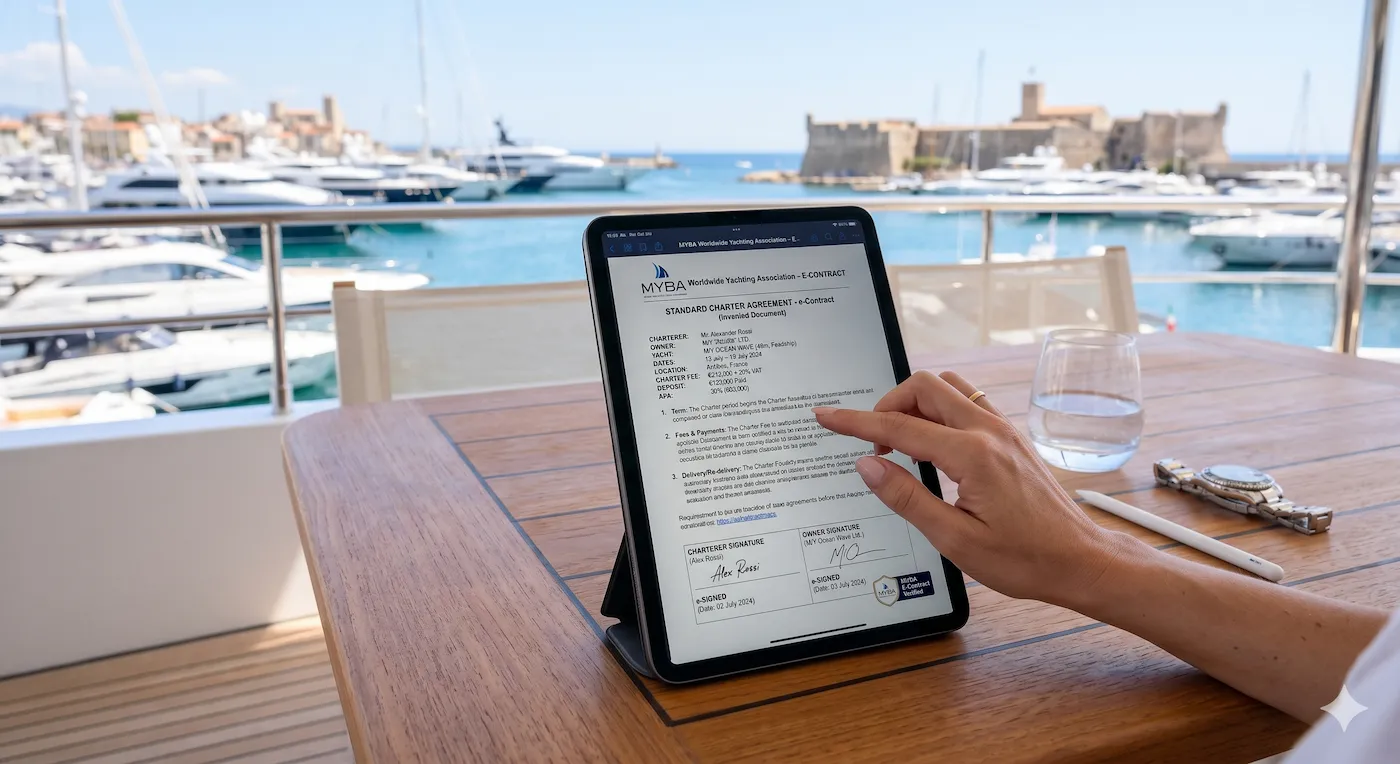
What is the MYBA E-Contract?
The MYBA E-Contract is the electronic version of the MYBA Charter Agreement — the industry-standard legal document that governs the vast majority of professional crewed yacht charters in Europe and the Mediterranean. MYBA stands for The Worldwide Yachting Association, and its charter agreement has been the backbone of the industry since the early 1990s.
The E-Contract is not simply a PDF. It is a digitally issued, serially numbered document generated directly from MYBA’s secure portal, with each contract assigned a unique serial number that can be independently verified. This system was introduced to eliminate forged or manipulated charter agreements — a real problem in an industry where contracts routinely involve deposits of €10,000 to €100,000 or more.
Any charter agreement that cannot be verified through the MYBA serial number validator should be treated with caution, regardless of how official it looks.
What’s inside a MYBA Charter Agreement
The agreement is deliberately short — around eight pages. The first part records the
particulars of your specific charter; everything after it is the standard terms, which
are the same for every MYBA charter and are the reason the form exists at all. Brokers, owners and
captains all know what they say, so negotiation focuses on the particulars.
Two points are worth understanding before anything else.
The stakeholder is not the owner. Charter funds do not go to the owner on signature —
they go to a stakeholder, usually the central agent, who releases them according to the contract. This
is what protects a charterer who has paid a six-figure deposit months before boarding, and it is also
why sanctions or KYC problems can freeze a charter even when both parties are acting in good faith.
The APA is money, not a fee. It is the charterer’s own funds, advanced to the captain to
cover fuel, berthing, provisioning and other running costs during the charter, and whatever is left is
returned. It is the single largest source of post-charter disputes, which is why it deserves its own
process — see our complete guide to APA
management and, for the wider financial picture, our guide to
running a charter end to end.
How to read the MYBA serial number
Every MYBA E-Contract displays its serial number prominently on the first page, in the format:
E-Contract N° 003022252601273724-02
Breaking this down:
- First 18 digits — the unique contract identifier generated by MYBA’s system at the time of issuance
- Suffix after the dash — the version number.
-01is the original contract.-02,-03etc. indicate amendments. Always check that you hold the latest version (is_last: truein the validator response).
If a contract number is presented to you without this structure, or if the validator returns no result, the document is not a genuine MYBA E-Contract.
Verify a MYBA E-Contract — live tool
Enter the serial number from your contract below. The validator checks directly against MYBA’s database in real time.
🔍 MYBA E-Contract Validator
This tool queries the MYBA association’s database directly. Results are real-time.
What changed in the 2025 MYBA update
The MYBA 2025 Charter Agreement, released in April 2025, is the first major revision since the 2017 version. The core payment structure and eight-page format remain intact, but six new clauses (26–31) address compliance realities that the 2017 version did not anticipate.
New clause 26 — KYC (Know Your Client)
Both the owner and the charterer are now contractually required to provide identity documentation before funds move. If a third party is paying on behalf of the charterer, they are also drawn into the KYC process. The contract can be cancelled if KYC compliance fails — and neither party can claim the other’s failure as a breach if the underlying reason is a legitimate compliance block.
New clause 27 — Data protection and privacy
Explicit GDPR-adjacent obligations for both parties on how personal data collected during the charter process is handled and retained.
New clause 28 — Confidentiality
Wider than the 2017 version, covering contract terms, documents executed under the agreement, and ownership information. Critically, this clause survives cancellation — it remains in force indefinitely even if the charter never takes place.
New clause 29 — Sanctions
A continuing warranty from both owner and charterer that neither party — nor any guest on board — is a sanctioned individual or entity. If a transfer is blocked due to sanctions compliance, the stakeholder may hold funds until legal clarity is obtained. This clause reflects the banking reality post-2022.
New clause 30 — Bank and transfer delays
Explicit liability carve-out: neither party is in breach if a payment is delayed due to banking compliance checks, provided the delay is notified promptly.
Modified clause — Payments
Payments must now originate from the charterer’s own bank account by default. Third-party payments require documented justification — an acknowledgment of the KYC reality many stakeholders already imposed informally.
Bottom line on 2025: If you are using a MYBA 2017 contract for a charter in 2025 or 2026, your broker or stakeholder may ask you to re-execute under the 2025 terms — particularly for charters involving non-EU parties or large deposits.
What KYC and sanctions mean in practice
For most charterers and owners completing a routine Mediterranean summer charter, the new KYC clause changes very little. Established brokers already run identity checks as a matter of course, and the 2025 language simply formalises what was already happening informally.
Where it matters more:
- First-time charterers — expect to provide a passport copy and proof of address before the deposit is processed. This is now contractually mandated, not just a broker preference.
- Third-party payments — if someone other than the charterer is paying (common in corporate charters), that party must also pass KYC. Budget extra time.
- Politically exposed persons (PEPs) — the sanctions clause creates a harder obligation. Some stakeholders will require enhanced due diligence, which can add 1–2 weeks to the contracting process.
- Large deposits — stakeholders now have explicit contractual cover to hold funds pending sanctions screening. If you are working to a tight embarkation deadline, get KYC documentation in early.
Practical guidance for captains and managers
From a captain’s perspective, the MYBA E-Contract is the document that defines your obligations for the entire charter period — including your APA responsibilities.
A few practical points:
- Always verify the serial number before the charter begins. Use the tool above. A contract that cannot be verified is not a valid MYBA E-Contract, regardless of what it looks like.
- Check the version suffix. If you hold a
-01and the charterer presents a-02amendment, make sure you have the latest version. Theis_lastfield in the validator tells you this instantly. - Under the 2025 agreement, your APA obligations remain unchanged in structure — but the financial environment around them is more tightly regulated. See our complete APA management guide for the full picture on managing funds on board.
- Clause 31 (behaviour) — the 2025 contract now explicitly allows immediate termination in cases of physical or sexual assault, possession of illegal drugs or weapons. As captain, you are the enforcement point for this clause on board.
Before you sign: the 8-point check
Most charter disputes are not caused by bad faith. They are caused by a particular that nobody read
carefully — a redelivery port that was never realistic, a guest count above what the yacht is certified
for, a cruising area that quietly excludes the one destination the charterer had in mind. Eight things
to confirm before the contract is executed:
- Delivery and redelivery are operationally possible. Check the passage time
between the two ports against the charter period, not against the brochure. A tight redelivery leaves
no margin for weather. - The guest count matches the yacht’s certification. Sleeping and cruising numbers
are limited by the vessel’s certificates, not by what fits around the table. Our guide to
yacht certificates and flag
state covers what governs this. - The cruising area covers the actual itinerary — including any country the
charterer has mentioned in passing. Adding it later requires the owner’s written agreement. - The APA percentage is realistic for the itinerary. A Mediterranean cruise with
long passages and marina berths burns through an APA faster than an anchoring-focused week. - VAT treatment is stated explicitly, not assumed. It depends on where the charter
starts and where the yacht cruises. - The payment schedule is compatible with KYC timing. Since the 2025 revision this
matters more: if a third party is paying, or the charterer is new, build in time before the deposit
deadline. - You hold the latest version. Check the serial number suffix and the
is_lastflag in the validator above. - The crew know the terms that concern them. The captain enforces the behaviour
clause, manages the APA and signs off the final accounts — the contract is an operational document, not
just a legal one.
How Scyllastar handles MYBA e-contracts
Scyllastar’s yacht charter management software is built around the MYBA framework. The charter module handles the full contract lifecycle — from initial booking through APA tracking, post-charter reconciliation, and owner reporting — with the MYBA E-Contract serial number logged against each charter record for audit purposes.
When a new charter is created in Scyllastar, the system prompts for the MYBA contract serial number and validates its format. This creates a traceable link between every financial transaction in the system and the underlying legal document — which matters when it comes to owner reporting, dispute resolution, and tax compliance across multiple flag states.
If your management company handles multiple charters per season across a fleet of yachts, having every contract, every APA transaction, and every owner disbursement tied to a verified MYBA serial number is the difference between a clean audit trail and a documentation nightmare.
Frequently asked questions
Is a MYBA charter agreement legally binding?
Yes. It is a contract between the owner and the charterer. MYBA itself is not a party to it — the
association publishes the standard form and, for e-contracts, issues and records the serial number.
Governing law and dispute resolution are set out in the standard terms.
What is the difference between the 2017 and 2025 versions?
The core structure is the same: same eight-page format, same payment logic, same APA mechanism. The
2025 revision adds six clauses (26 to 31) covering KYC, data protection, confidentiality, sanctions,
banking delays and guest behaviour, and tightens the rule on who may pay.
Can I still use the 2017 form?
It remains a valid contract if both parties execute it. But brokers and stakeholders increasingly ask
for the 2025 terms, particularly where non-EU parties or large deposits are involved, because the
compliance clauses protect them too.
Who holds the charter funds?
The stakeholder named in the contract — usually the central agent — not the owner. Funds are released
according to the agreement, which is what protects a charterer paying months in advance.
Is the APA part of the charter fee?
No. The APA is the charterer’s own money, advanced to cover running costs during the charter, and the
unspent balance is returned at the end. It is typically 30–35% of the base fee, more on larger yachts.
Our APA guide explains how to track
and close it cleanly, and our
financial administration
guide covers where it sits in the yacht’s wider accounts.
What if the serial number does not validate?
Treat the document as unverified. A genuine MYBA E-Contract always resolves in the association’s
database. If the validator returns nothing, ask the broker to reissue from the MYBA portal before any
money moves.
This article was written by the Scyllastar team. Contract terms referenced are based on the MYBA 2025 Charter Agreement. Always consult a qualified maritime lawyer for advice specific to your situation.