
A yacht logbook is the vessel’s official memory — the continuous, dated record of where the yacht went, what happened on board, and that the master met their legal obligations. When something goes wrong on board — an incident, an injury, a dispute, a port state inspection — the yacht logbook is the first document anyone asks to see, and a clean one protects the master and the owner alike.
This guide covers what a yacht’s logbook must record, the rules behind it, and how the deck log, voyage records, drills and port-entry lists fit together.
1. What a ship’s logbook is — and why it is mandatory
A ship’s logbook is the formal, chronological record of a vessel’s operation. It is not a private diary: on a commercially registered yacht it is a legal document that flag states, port authorities, insurers and courts can require. It evidences that watches were kept, that drills were held, that navigation was conducted safely, and that rest-hour and safety obligations were met.
A well-kept log is, quite simply, the master’s best defence. Vague, back-filled or missing entries are the opposite — they turn a routine inspection into a problem.
2. The legal backbone: SOLAS, MLC, flag state and COLREGs
Several instruments require logbook entries, and a yacht’s log sits at the intersection of all of them:
- SOLAS — records of navigation, drills, and the maintenance of life-saving and fire-fighting appliances.
- COLREGs / navigation — the deck log evidences safe watchkeeping, positions, course and speed changes.
- MLC 2006 — records of hours of work and rest, tied to the crew’s rest-hour declarations.
- ISPS — security-related records, including security drills and level changes.
- Flag state — each registry sets its own official logbook format and retention rules.
A commercial yacht also carries this discipline into its ISM safety management system, where drills and records are audited.
3. The official/deck log: what must be recorded
The deck log is the core. Typical entries include the date and time of every significant event, the vessel’s position, course and speed, weather and sea state, departures and arrivals, bunkering, and any incident, injury or unusual occurrence. Entries are made as events happen, in ink or in a tamper-evident electronic system — never reconstructed from memory at the end of the week.
4. Voyage records and port movements
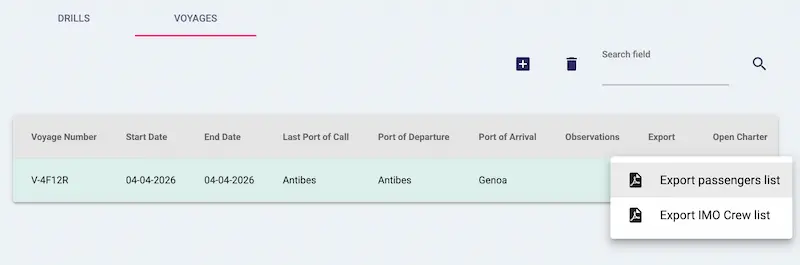
Each voyage — departure port, route, arrival port, times and distances — forms a record that ties together the deck log, fuel consumption and the crew and guest manifests for that passage. A structured voyage record makes the rest almost automatic: port formalities, charter reconciliation and fuel tracking all hang off the same trip.
5. Recording safety and security drills
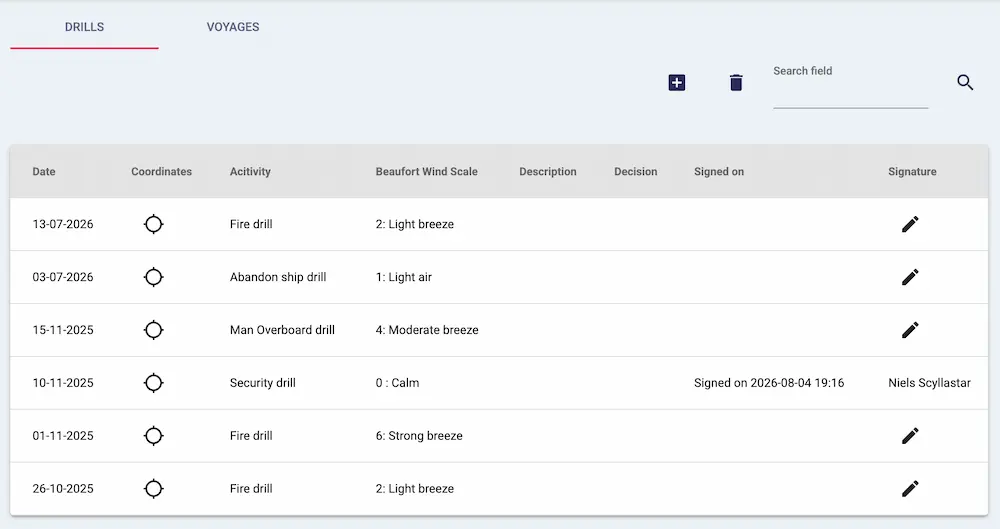
SOLAS and ISPS require regular drills — abandon ship, fire, man overboard, and security drills — held at defined intervals and recorded with the date, the scenario, who took part and any lessons learned. These records are prime audit material: an inspector who finds drills logged consistently, on schedule, reads a well-run vessel immediately. Missing or bunched-up drill entries do the opposite.
6. Crew and passenger lists at port entry (FAL forms)
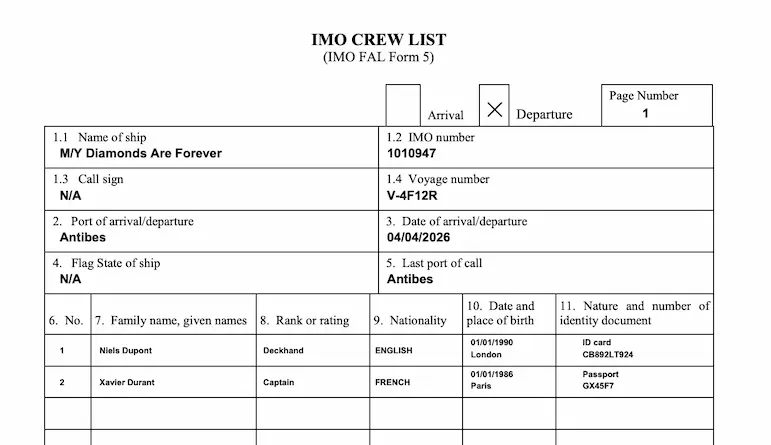
Every time a yacht enters a new port, the authorities expect a crew list (IMO FAL Form 5) and, when guests are aboard, a passenger list (FAL Form 6). On a busy season this means producing the same lists over and over. When the logbook and the crew records share the same data, the lists export in one click from the voyage rather than being retyped each time.
7. Who keeps the log, and how often
Ultimate responsibility for the logbook rests with the master, but entries are made by whoever holds the watch or runs the relevant operation — officers on the deck log, the engineer on the engine-room log. The rule is continuity: the log is kept live, entry by entry, so that at any moment it is complete up to now. A log that is only ever written up before an inspection is worse than useless — it is evidence of poor practice.
8. Paper vs electronic logbooks
Traditional logs are bound paper books; increasingly, flag states accept electronic logbooks provided they are secure, time-stamped and tamper-evident, with entries attributable to a named person. A digital log removes the shoebox problem, makes records searchable and exportable, and — crucially — links the log to voyages, drills, crew hours and certificates instead of leaving each on its own island of paper.
9. Common logbook mistakes
- Entries reconstructed at the end of a passage instead of logged as events happen.
- Drills recorded in bunches to “catch up” before an audit.
- Crew and passenger lists retyped from scratch at every port.
- Gaps in position or watch records that cannot be explained.
- A logbook that lives entirely on paper and cannot be produced quickly when asked.
10. A logbook connected to the rest of the vessel
A logbook is far more useful when it is not an island. In Scyllastar, the logbook is part of the wider vessel management platform: voyages feed the crew and passenger lists, drills are logged against the schedule, hours of work and rest connect to the crew module, and everything is time-stamped and exportable. The record keeps itself as the vessel operates — which is exactly what a clean logbook is supposed to do.
Frequently asked questions
Is a ship’s logbook mandatory on a yacht?
Yes. On a commercially registered yacht the logbook is a legal document required by SOLAS, MLC, ISPS and the flag state. It records navigation, drills, hours of rest and incidents, and must be produced on request at inspection.
Can a yacht keep an electronic logbook?
Increasingly yes — many flag states accept electronic logbooks provided they are secure, time-stamped, tamper-evident and attributable to a named person. Entries must still be made as events happen, not reconstructed later.
Who is responsible for a yacht’s logbook?
The master holds ultimate responsibility, but entries are made by whoever holds the relevant watch or operation — officers on the deck log, engineers on the engine-room log. The log is kept live, entry by entry.