
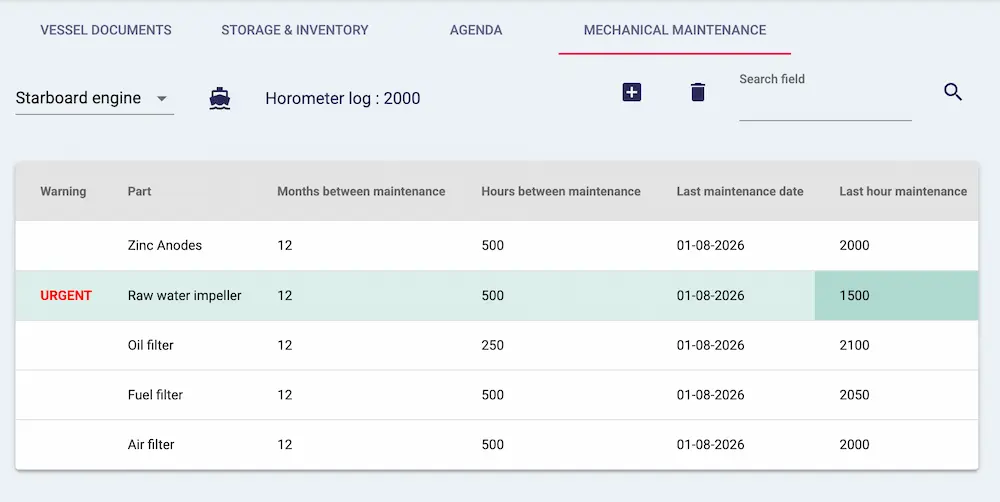
A yacht is a floating collection of machinery that never stops working — main engines, generators, stabilisers, watermakers, HVAC, tenders, sewage and hydraulics — often run hard for a few intense months, then laid up. A planned maintenance system (PMS) is what keeps that machinery serviced on schedule rather than fixed after it fails. Done well, it is the difference between a quiet season and a generator dying with guests aboard.
This guide explains what a PMS is, how it works on a yacht, who runs it, what class and flag expect, and how to build one that the chief engineer will actually keep up to date.
1. What a planned maintenance system actually is
A PMS is a structured register of every piece of equipment on board, each with its maintenance tasks, the interval at which each task is due, and a record of when it was last done. Instead of relying on memory or a paper folder in the engine room, the system tells you — for every machine — what is due, what is overdue, and what is coming up.
At its core a PMS answers three questions at all times: what needs doing, when, and was the last one signed off? Everything else is detail.
2. Two clocks: calendar dates vs running hours
Yacht maintenance runs on two clocks, and a good PMS tracks both:
- Calendar intervals — tasks due by date regardless of use: annual servicing, liferaft and EPIRB certifications, anode inspections, oil analysis. These tick whether the boat moves or sits.
- Running hours (the hour-meter) — tasks due after a set number of operating hours: engine oil and filter changes every 250/500 hours, impeller and belt replacements, generator top-end services. A machine that runs 1,200 hours in a charter season needs servicing far more often than the calendar suggests.
The art of a yacht PMS is combining the two: whichever comes first — the hours or the date — triggers the job. The chief engineer logs running hours regularly, and the system counts down to the next service on both clocks at once.
3. What belongs in a yacht PMS
A workable PMS is built from a few simple building blocks:
- Equipment register — every serviceable item, with make, model, serial number and location on board.
- Maintenance tasks — for each item, the jobs to perform (change oil, inspect, test, replace part) with a clear description.
- Intervals — the calendar and/or running-hours frequency for each task, taken from the manufacturer’s manual.
- Records — the history: when each task was last completed, by whom, with any notes and the hour-meter reading at the time.
- Linked spares — the parts each task consumes, so a due service also tells you whether the part is on board.
Kept together, these turn a pile of manuals into a living schedule the whole engineering team can follow.
4. Who owns the PMS on board
The PMS belongs to the chief engineer. They define the plan — which tasks, which intervals — because they know the machinery and the manufacturer requirements. On smaller yachts without a dedicated engineer, the captain owns it, usually with support from a shore-side technical manager.
The captain and the management company consume the output: they need visibility that critical maintenance is on schedule, that overdue jobs are being cleared, and that the vessel’s technical records are clean — because those records are exactly what a surveyor, a flag inspector or a buyer’s technical adviser will ask to see. Maintenance is engineering work; keeping the whole vessel’s records in one place is a management discipline.
5. Class and flag: when a PMS replaces survey
For commercially registered yachts, a PMS is not optional. Under the ISM Code, the Safety Management System requires that shipboard equipment and technical systems be maintained to a documented plan, with records kept. A neglected PMS is a straightforward ISM non-conformity at audit.
Beyond compliance, classification societies offer Planned Maintenance Schemes in lieu of survey (often called PMS or CMS — Continuous Machinery Survey). Once approved, the vessel’s own maintenance records — properly kept and periodically confirmed by a class surveyor — can satisfy machinery survey requirements, spreading the work across the year instead of a single yard period. That only works if the records are complete, dated and trustworthy: the paper trail is the survey.
6. Building the plan: from manufacturer manual to working schedule
Building a PMS from scratch looks daunting; in practice it is methodical:
- Inventory the machinery. Walk the vessel and list every serviceable item with its details — engines, generators, pumps, HVAC, deck and safety equipment.
- Pull the intervals. For each item, take the maintenance tasks and their calendar/hours intervals straight from the manufacturer’s manual.
- Set the baseline. Record current running hours and the date of the last known service for each task, so the countdown starts from reality, not zero.
- Prioritise the critical. Flag the equipment whose failure stops the yacht or endangers safety — start there, expand later.
- Keep it maintainable. A plan with 2,000 micro-tasks nobody updates is worse than 200 that are always current.
Start lean and grow it. A PMS earns trust by being right about the jobs that matter, not by being exhaustive on paper.
7. Running it day to day
A PMS only works if it is fed. The daily discipline is small but non-negotiable:
- Log running hours regularly — ideally the system reads or records the hour-meter so countdowns stay accurate.
- Close out completed jobs immediately, with the date, the engineer’s name, the hour reading and a short note.
- Attach evidence where it matters — an oil-analysis result, a photo of a replaced part, a test certificate.
- Review what is due and overdue at a set cadence (weekly under way), and plan the next port or yard period around it.
Servicing then happens because it is due, not because something broke — which is the entire point.
8. Spares and inventory: the other half of the system
A maintenance task is only as good as the part it needs. A service due in 40 hours is useless information if the filter is not on board and the yacht is three days from a chandlery. That is why a serious PMS links each task to its spare parts, and the spares to the vessel’s inventory.
Get that link right and the system does something powerful: it turns upcoming maintenance into a provisioning list automatically — order these parts before the next leg — instead of a scramble when the job comes due. Maintenance and inventory are two halves of the same discipline, not separate spreadsheets.
9. Red flags of a failing PMS
- Maintenance is remembered, not scheduled — jobs happen when someone recalls them.
- No running-hours tracking, so hour-based services are guessed.
- Records live in one engineer’s head or personal notebook, and leave when they do.
- Overdue tasks pile up with no visibility to the captain or manager.
- Spares are discovered missing at the moment the job is due.
- At handover between engineers, nobody can say what was last done to what.
Any two of these together mean the vessel is running on luck. Machinery failure is rarely sudden; it is usually a missed service that nobody was tracking.
10. Spreadsheet vs dedicated PMS software
A spreadsheet can run a basic PMS, and for a small private yacht it may be enough. It breaks down at scale: it does not count running hours for you, does not alert on what is due, does not survive an engineer handover, and does not connect to spares or to the rest of the vessel’s records.
A dedicated PMS does the counting and the alerting automatically, keeps a clean audit-ready history for class and flag, and links maintenance to inventory and to the yacht’s documents. In Scyllastar, planned maintenance is part of the broader vessel management platform: the engineer defines the plan, the hour-meter drives the schedule, spares are linked, and the captain and manager see at a glance that the boat is serviced and compliant — one system for the whole vessel, not a folder in the engine room.
Frequently asked questions
What is a planned maintenance system (PMS) on a yacht?
A PMS is a structured schedule of maintenance tasks for a yacht’s machinery, defined by the chief engineer and driven by running hours (the hour-meter) and calendar intervals. It raises each job at the right moment so servicing happens on schedule instead of after a breakdown.
Is a planned maintenance system mandatory on a yacht?
For commercial yachts, planned maintenance is effectively required as part of the ISM Safety Management System, and an approved PMS can be accepted in lieu of certain surveys. Private yachts are not obliged to run one, but most do because it protects the asset and its resale value.
How does the hour-meter drive maintenance intervals?
Many components are serviced by running hours rather than dates — for example an engine service every set number of hours. The PMS tracks each machine’s hour-meter and raises the task when the interval is reached, alongside calendar-based tasks.