
On the evening of Wednesday 12 August 2026, the Moon’s shadow will sweep out of the Atlantic, cross northern Spain, and leave the Earth over the western Mediterranean just as the sun goes down. For roughly ninety seconds, the sea south-west of Mallorca will go dark.
The timing is close to absurd. Mid-August is the single busiest week of the Mediterranean season. Our AIS study of the world fleet found that 51% of the world’s leisure yachts over 18 metres — 6,187 vessels — were in the Mediterranean, and a large share of them are within a day’s steaming of the path of totality. Very few of those crews know it yet.
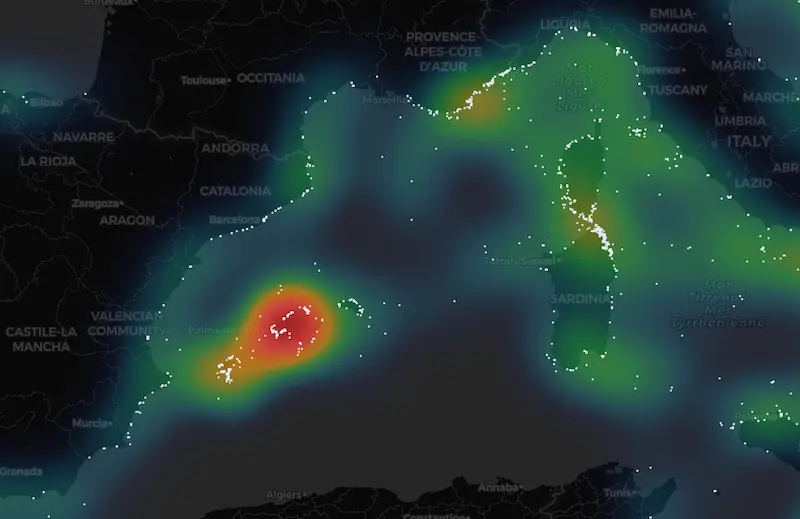
The map above is that fleet, and it makes the point better than any table can: the hottest concentration of yachts in the western Mediterranean sits on the Balearics, around Palma — which is exactly where the Moon’s shadow lands. A large part of the fleet is already in the best place in Europe to watch this.
This guide gives you the real numbers: first contact, maximum, how much of the sun is covered, how high the sun actually is, and when it sets. That last pair matters more than anything else, and it is the part most eclipse articles leave out.
- Date: Wednesday 12 August 2026, at sunset (all times below are local time at the place named).
- Totality in the Mediterranean: the Balearics and the Valencia–Tarragona coast only.
- Longest totality afloat: about 1 min 35 s off south-west Mallorca.
- Sun height at maximum: between 1° and 4° almost everywhere. Roughly a finger’s width above the horizon.
- Nowhere in the Mediterranean sees the eclipse finish. The sun sets, still partly covered, at every single port in this article.
Where totality actually falls
The path of totality comes ashore in north-west Spain, runs diagonally across the country, and exits over the Balearics. Anywhere else in the Mediterranean gets a partial eclipse — sometimes a spectacular 99% partial, but a partial, which is a fundamentally different experience.
Inside the Mediterranean, these are the places that see the sun disappear completely:
| Place | Eclipse starts | Maximum | Covered | Totality | Sun height | Sunset |
|---|---|---|---|---|---|---|
| 🇪🇸 Port Adriano | 19:38 | 20:32 | 100% | 1 min 36 s | 2.2° | 20:49 |
| 🇪🇸 Palma de Mallorca | 19:38 | 20:32 | 100% | 1 min 35 s | 2.1° | 20:48 |
| 🇪🇸 Ibiza | 19:39 | 20:33 | 100% | 1 min 10 s | 2.6° | 20:52 |
| 🇪🇸 Valencia | 19:38 | 20:33 | 100% | 1 min 08 s | 4.1° | 21:00 |
| 🇪🇸 Mahón (Menorca) | 19:37 | 20:31 | 100% | 1 min 04 s | 1.2° | 20:42 |
| 🇪🇸 Tarragona | 19:36 | 20:30 | 100% | 0 min 49 s | 3.9° | 20:57 |
Note how sharply the trade-off runs. Palma and Port Adriano get the longest totality — around 1 min 35 s — but the sun is only 2° above the horizon when it happens. Valencia gets a shorter 1 min 08 s, but with the sun twice as high at 4.1°, which means a much better chance of actually seeing it over haze, coastal murk and anything on the skyline.
And then there is Barcelona at 99.7%. That sounds like a rounding error away from totality. It is not. At 99.7% the corona does not appear, the horizon does not go dark, and the difference between what Barcelona sees and what Palma sees is the whole point of the event. And Barcelona is only 23 nautical miles from the nearest water that sees totality. For a yacht, that is a two-hour problem, not a missed opportunity.
The number nobody mentions: the sun will be 1–4° high
Every table you will read about this eclipse gives you percentages. Almost none give you the altitude of the sun, and for this particular eclipse that is the single most important figure on the page.
Across the whole northern Mediterranean, maximum eclipse happens with the sun between 1.2° and 4.1° above the horizon. For scale: hold your arm out straight and your little finger is about 1° wide; your closed fist is about 10°. The eclipsed sun will be roughly one to four fingers above the horizon line.
That has a brutal practical consequence. On the French Riviera the sun sets to the west-north-west — straight into the Estérel, the Alpes-Maritimes foothills, and the entire built-up shoreline. In Genoa and Portofino it sets behind the Ligurian hills. From most beaches, most terraces and most marina berths on the north side of the Med, the sun will already be behind something solid before maximum. The numbers in the tables below assume a flat, unobstructed sea horizon. Ashore, you will rarely have one.
Full timetable, port by port
All times are local time on 12 August 2026. “Maximum” is the moment of greatest coverage that you can actually see — where the sun sets before the geometric maximum, the figure shown is the moment of sunset and the coverage reached by then, marked with a dagger (†).
We have deliberately left out a “last contact” column. In every port listed here, the sun sets before the eclipse ends: fourth contact falls between 20:21 and 21:31 local, always below the horizon. Nowhere in the Mediterranean sees this eclipse finish.
Spain, the Balearics and Gibraltar
| Place | Eclipse starts | Maximum | Sun covered | Sun height | Sunset |
|---|---|---|---|---|---|
| 🇪🇸 Palamós | 19:34 | 20:28 | 98.9% | 3.1° | 20:50 |
| 🇪🇸 Barcelona | 19:35 | 20:29 | 99.7% | 3.5° | 20:53 |
| 🇪🇸 Sitges | 19:35 | 20:30 | 99.9% | 3.6° | 20:55 |
| 🇪🇸 Tarragona | 19:36 | 20:30 | 100% | 3.9° | 20:57 |
| 🇪🇸 Palma de Mallorca | 19:38 | 20:32 | 100% | 2.1° | 20:48 |
| 🇪🇸 Port Adriano | 19:38 | 20:32 | 100% | 2.2° | 20:49 |
| 🇪🇸 Ibiza | 19:39 | 20:33 | 100% | 2.6° | 20:52 |
| 🇪🇸 Mahón (Menorca) | 19:37 | 20:31 | 100% | 1.2° | 20:42 |
| 🇪🇸 Valencia | 19:38 | 20:33 | 100% | 4.1° | 21:00 |
| 🇪🇸 Dénia | 19:39 | 20:34 | 100% | 3.4° | 20:57 |
| 🇪🇸 Alicante | 19:40 | 20:35 | 99.3% | 3.6° | 20:58 |
| 🇪🇸 Gibraltar | 19:44 | 20:39 | 93.1% | 5.8° | 21:14 |
France, Monaco and Corsica
| Place | Eclipse starts | Maximum | Sun covered | Sun height | Sunset |
|---|---|---|---|---|---|
| 🇫🇷 Perpignan | 19:33 | 20:27 | 98.0% | 3.7° | 20:53 |
| 🇫🇷 Montpellier | 19:31 | 20:25 | 96.5% | 3.6° | 20:51 |
| 🇫🇷 Marseille | 19:32 | 20:25 | 96.2% | 2.5° | 20:45 |
| 🇫🇷 Toulon | 19:32 | 20:25 | 96.2% | 2.0° | 20:42 |
| 🇫🇷 Saint-Tropez | 19:32 | 20:25 | 95.7% | 1.6° | 20:39 |
| 🇫🇷 Cannes | 19:31 | 20:24 | 95.2% | 1.6° | 20:38 |
| 🇫🇷 Antibes | 19:31 | 20:24 | 95.1% | 1.5° | 20:38 |
| 🇫🇷 Nice | 19:31 | 20:24 | 94.9% | 1.5° | 20:38 |
| 🇲🇨 Monaco | 19:31 | 20:24 | 94.8% | 1.4° | 20:37 |
| 🇫🇷 Ajaccio | 19:33 | 20:26 | 96.6% | ≈0° | 20:28 |
| 🇫🇷 Bonifacio | 19:34 | 20:25 | ~96% | 0° † | 20:25 |
Italy, Sardinia and Sicily
| Place | Eclipse starts | Maximum | Sun covered | Sun height | Sunset |
|---|---|---|---|---|---|
| 🇮🇹 Genoa | 19:29 | 20:22 | 93.5% | 0.9° | 20:33 |
| 🇮🇹 Portofino | 19:30 | 20:22 | 93.5% | 0.7° | 20:31 |
| 🇮🇹 La Spezia | 19:30 | 20:22 | 93.5% | ≈0° | 20:28 |
| 🇮🇹 Viareggio | 19:30 | 20:23 | 93.6% | ≈0° | 20:26 |
| 🇮🇹 Livorno | 19:31 | 20:23 | 94.0% | ≈0° | 20:25 |
| 🇮🇹 Porto Cervo | 19:35 | 20:23 | ~93% | 0° † | 20:23 |
| 🇮🇹 Porto Rotondo | 19:35 | 20:23 | ~92% | 0° † | 20:23 |
| 🇮🇹 Cagliari | 19:38 | 20:21 | ~82% | 0° † | 20:21 |
| 🇮🇹 Rome | 19:33 | 20:14 | ~74% | 0° † | 20:14 |
| 🇮🇹 Naples | 19:34 | 20:04 | ~50% | 0° † | 20:04 |
| 🇮🇹 Capri | 19:34 | 20:04 | ~48% | 0° † | 20:04 |
| 🇮🇹 Amalfi | 19:34 | 20:02 | ~45% | 0° † | 20:02 |
| 🇮🇹 Palermo | 19:38 | 20:03 | ~37% | 0° † | 20:03 |
| 🇮🇹 Venice | 19:27 | 20:19 | 91.2% | ≈0° | 20:21 |
| 🇮🇹 Trieste | 19:27 | 20:16 | ~89% | 0° † | 20:16 |
Adriatic and Malta
| Place | Eclipse starts | Maximum | Sun covered | Sun height | Sunset |
|---|---|---|---|---|---|
| 🇭🇷 Rijeka | 19:27 | 20:13 | ~83% | 0° † | 20:13 |
| 🇭🇷 Zadar | 19:29 | 20:07 | ~68% | 0° † | 20:07 |
| 🇭🇷 Split | 19:29 | 20:01 | ~52% | 0° † | 20:01 |
| 🇭🇷 Hvar | 19:30 | 20:00 | ~50% | 0° † | 20:00 |
| 🇭🇷 Dubrovnik | 19:30 | 19:52 | ~33% | 0° † | 19:52 |
| 🇲🇪 Kotor | 19:30 | 19:49 | ~26% | 0° † | 19:49 |
| 🇲🇹 Valletta (Malta) | 19:41 | 19:54 | ~15% | 0° † | 19:54 |
North Africa
| Place | Eclipse starts | Maximum | Sun covered | Sun height | Sunset |
|---|---|---|---|---|---|
| 🇲🇦 Tangier | 18:45 | 19:40 | 92.2% | 6.0° | 20:15 |
| 🇩🇿 Oran | 18:45 | 19:39 | 95.1% | 2.2° | 19:54 |
| 🇩🇿 Algiers | 18:43 | 19:36 | 98.5% | ≈0° | 19:41 |
| 🇹🇳 Bizerte | 18:40 | 19:15 | ~60% | 0° † | 19:15 |
| 🇹🇳 Tunis | 18:41 | 19:13 | ~54% | 0° † | 19:13 |
| 🇹🇳 Sfax | 18:44 | 19:07 | ~34% | 0° † | 19:07 |
| 🇹🇳 Djerba | 18:45 | 19:05 | ~28% | 0° † | 19:05 |
† The sun sets before the eclipse reaches its maximum. The time and percentage shown are those at sunset — the peak happens below the horizon and is never visible.
Where the sun sets before the eclipse peaks
This is where most published tables go wrong, and where the difference matters most. In a broad band running from Sardinia through central and southern Italy, the Adriatic, Malta and Tunisia, the sun sets while the eclipse is still deepening. The theoretical maximum happens below the horizon and is never seen by anyone.
The consequences are stark. Rome reaches about 75% at sunset (20:14) and stops there. Naples gets to roughly 50%, Split to about 52%, Dubrovnik to 33%, Kotor to 26%, and Valletta to a mere 15% before the sun is gone. Tunis manages about 54%.
The cruel case is Palermo. Sicily is geometrically inside the very end of the path of totality — but the umbra arrives at 20:29, and the sun sets at 20:03. Palermo is, on paper, a total eclipse city that will see 37% and then a sunset. The same applies to Tunis and Bizerte, which are also inside the theoretical path with the sun already below the horizon.
Sardinia sits right on the knife edge. Bonifacio and Ajaccio just hold on, reaching around 96–97% with the sun on the horizon. Porto Cervo gets to 93% and Cagliari to 82% before sunset cuts them off — despite Cagliari’s geometric maximum being a near-total 99.8%.
Greece and Turkey: nothing at all
If you are cruising the Ionian, the Aegean or the Turkish coast, the honest answer is that there is nothing to see. In Athens, Mykonos and Bodrum the sun sets before the eclipse even begins. Corfu, the westernmost of the four, gets about five minutes of a 4% bite taken out of a sun already touching the horizon — which in practice you will not notice.
| Place | Sunset | Eclipse would start | What you will see |
|---|---|---|---|
| 🇬🇷 Corfu | 20:39 | 20:34 | About five minutes of a 4% nibble, right on the horizon. Effectively invisible. |
| 🇬🇷 Athens | 20:21 | 20:34 | Nothing. The sun sets 13 minutes before first contact. |
| 🇬🇷 Mykonos | 20:13 | 20:34 | Nothing. The sun sets 21 minutes before first contact. |
| 🇹🇷 Bodrum | 20:04 | 20:34 | Nothing. The sun sets 30 minutes before first contact. |
Why a yacht is the best seat in Europe
Put the two constraints together — totality confined to the Balearics and the Valencia coast, and a sun sitting 2° above the horizon — and a yacht stops being a nice way to watch this eclipse and becomes close to the only good one.
A vessel gives you three things no shoreside viewpoint can: a genuinely flat sea horizon in the west-north-west, the ability to move if the forecast turns, and the freedom to sit on the centreline rather than wherever the road happens to end. From most of the western Med, the path is a single overnight passage away.
These are positions on or close to the centreline, with the circumstances we calculate for each. They are given for planning only — they are not a passage plan, and normal navigation, traffic separation and local restrictions all still apply:
| Position | Decimal | Maximum | Totality | Sun height |
|---|---|---|---|---|
39°12′N 002°21′E |
39.20 N / 2.35 E | 20:32 | 1 min 33 s | 2.1° |
39°03′N 001°57′E |
39.05 N / 1.95 E | 20:33 | 1 min 26 s | 2.3° |
39°12′N 001°27′E |
39.20 N / 1.45 E | 20:33 | 1 min 26 s | 2.7° |
39°42′N 003°36′E |
39.70 N / 3.60 E | 20:31 | 1 min 25 s | 1.5° |
39°27′N 000°06′W |
39.45 N / 0.10 W | 20:33 | 1 min 14 s | 3.9° |
40°42′N 001°36′E |
40.70 N / 1.60 E | 20:30 | 1 min 12 s | 3.5° |
40°51′N 001°45′E |
40.85 N / 1.75 E | 20:30 | 0 min 57 s | 3.4° |
The strategic choice is the one visible in that table. Head for the waters south and west of Mallorca and you buy the longest totality, around 1 min 30 s, with the sun very low at roughly 2°. Head for the approaches to Valencia and you lose about twenty seconds of totality but gain almost two degrees of altitude — which, on an evening when coastal haze is the main enemy, is very likely the better trade.
The distances are smaller than most people assume. From Barcelona, the nearest water that sees totality is 23 nautical miles away — though we would push out to 35 or 40 for a usable margin and a longer eclipse. From Palamós and the Costa Brava it is about 67 nautical miles: a morning departure on the 12th, comfortably. From Ajaccio or Porto Cervo it is roughly 190 nautical miles, and from Antibes, Monaco or Saint-Tropez around 235 to 250 — a single overnight passage, long but entirely ordinary for the boats that are already there.
For charter operations, this is also a genuinely marketable moment. A guest programme built around the evening of the 12th — a position on the centreline, a briefed crew, glasses aboard for everyone, dinner afterwards — is the kind of thing that gets remembered and rebooked. Worth flagging to owners and brokers now rather than on the day.
Eye safety at 2° above the horizon
A very low sun looks harmless. It is not, and this eclipse is unusually good at fooling people, because a deep-orange sun sitting on the horizon feels safe to stare at in a way a midday sun never does.
The rule does not change with altitude: during every partial phase — which, for everyone outside the Balearics and the Valencia coast, means the entire event — the sun must be viewed through filters certified to ISO 12312-2. Sunglasses do not qualify, no matter how dark. Neither does a welding mask below shade 14, exposed film, a smoked plate, a CD, or looking at the reflection in the water.
The one exception is the brief window of totality itself, in the Balearics and off the Valencia coast: while the sun is completely covered, and only then, filters come off and the corona is safe to view with the naked eye. Filters must go back on the instant the first bead of sunlight returns.
Optics need their own protection. Binoculars, camera lenses, drone cameras and — very much including — the bridge’s own optics concentrate sunlight enough to cause injury in under a second. A filter must be fitted in front of the objective lens, never between the eyepiece and the eye.
A bridge and interior checklist
A partial solar eclipse is not a safety event in itself, but it lands at the end of a busy summer day, in crowded anchorages, with guests on deck looking in one direction. A short list is worth having:
- Confirm your own numbers. Take the times for your actual position, not the nearest big city — the tables above shift by several minutes over quite short distances.
- Check the bearing. Maximum happens to the west-north-west and very low. Swing, headland, breakwater and a neighbouring 80-metre all matter. If you are on a single anchor in a crowded bay, think about where you will be lying at 20:25.
- Glasses aboard, counted, before the day. ISO 12312-2, one per person, plus spares. They will not be available locally on the 12th.
- Brief early. Guests, crew, and anyone who will be on a tender. Include the “never through binoculars or a camera” rule explicitly.
- Expect the anchorages to fill. Balearic bays with a clean western horizon are going to be busy on the evening of the 12th. Arrive early and set properly.
- Expect traffic and radio congestion in the Balearics and on the Valencia coast through the afternoon, and a mass departure after dark.
- Plan the light. Navigation lights on before the light drops, and remember the twilight will arrive faster and stranger than the crew expects.
- Log it. Position, times, conditions. It is a genuinely unusual entry, and guests love being shown it afterwards.
If you miss it: 2 August 2027
The consolation is unusually good. On 2 August 2027, less than a year later, another total eclipse crosses southern Spain, Gibraltar, Morocco, Algeria, Tunisia, Libya and Egypt — and that one is a monster, with over six minutes of totality at its centre and the sun high in the sky rather than scraping the horizon.
For Mediterranean operators, 2027 is the eclipse worth planning a season around. 2026 is the one worth moving the boat 50 miles for.
How these figures were calculated
The times, coverage figures, totality durations and solar altitudes in this article were computed from NASA’s published Besselian elements for the total solar eclipse of 12 August 2026 (reference epoch 18:00:00 TDT, ΔT = 72.2 s), evaluated for the geographic coordinates of each location. Sunset times are apparent sunset of the upper limb at sea level, including standard atmospheric refraction.
Two caveats worth stating plainly. First, every figure assumes an unobstructed sea-level horizon; ashore, terrain and buildings will cut the event short, sometimes by many minutes. Second, coverage figures near sunset are sensitive to your exact position and to refraction close to the horizon, so treat the low-altitude numbers as good to a percentage point or two rather than to the decimal.
Percentages given are obscuration — the fraction of the sun’s visible area covered — which is not the same as magnitude, the fraction of its diameter. Magnitude figures are always the larger of the two, and the two are frequently confused in eclipse coverage.