
Every summer, the Mediterranean quietly rearranges itself. A few thousand of the world’s largest leisure yachts slip their lines and drift toward the same handful of bays — and when you plot the world’s superyachts on a map, a story appears. It is not random. The fleet follows glamour, geography, shipyards and season, and the pattern it leaves behind tells you exactly where the industry’s centre of gravity sits in 2026.
The data is a single AIS snapshot taken on 31 July 2026: we tracked 255,236 vessels broadcasting on AIS worldwide and isolated the 14,771 leisure yachts over 18 metres that this study is built on. We will repeat the exercise at other dates through the year, so treat this as a moment in time, not a season average. First, that fleet itself — by type, by size and by region.
First, the big picture: who is actually out there
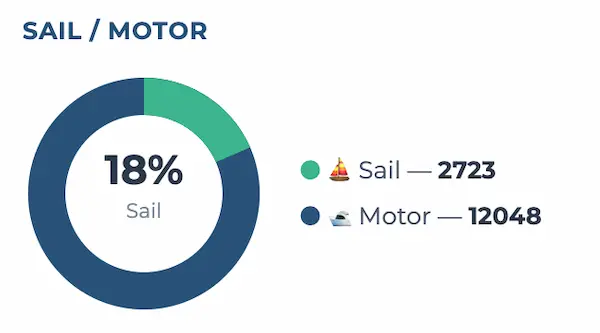
Start with the split that surprises newcomers: the large-yacht world is overwhelmingly a motor world. Of the fleet tracked, 82% are motor yachts (12,048) and just 18% are sailing yachts (2,723).
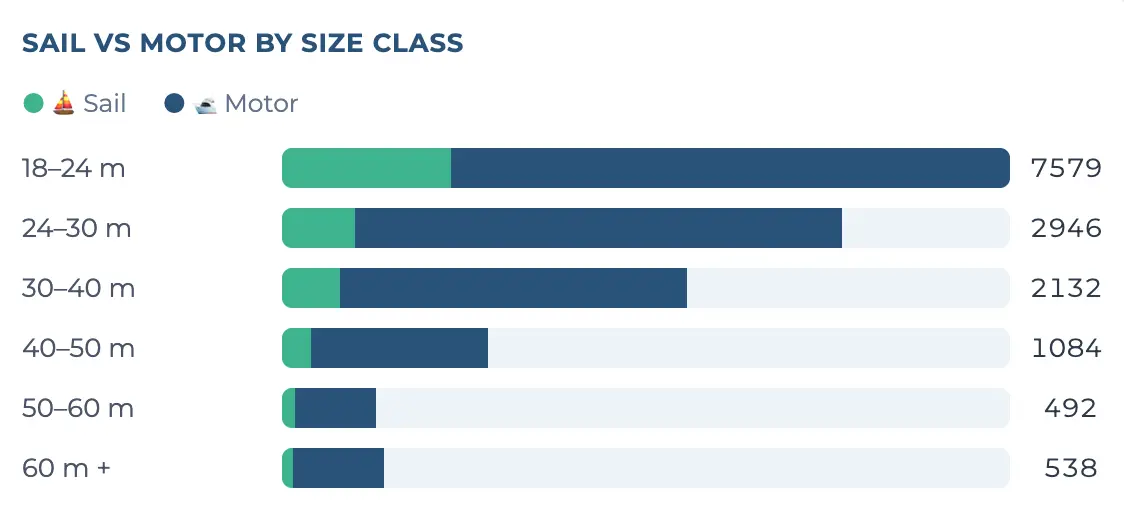
Break it down by size and a second pattern appears. The fleet is dominated by the smaller classes — 7,579 yachts in the 18–24 m band alone — and thins quickly as length grows: 2,946 in 24–30 m, 2,132 in 30–40 m, then 1,084, 492 and finally 538 in the open-ended 60 m-plus club. Sail is essentially a small-yacht phenomenon: its green shrinks band by band and all but disappears above 40 metres, where the fleet is almost entirely motor.
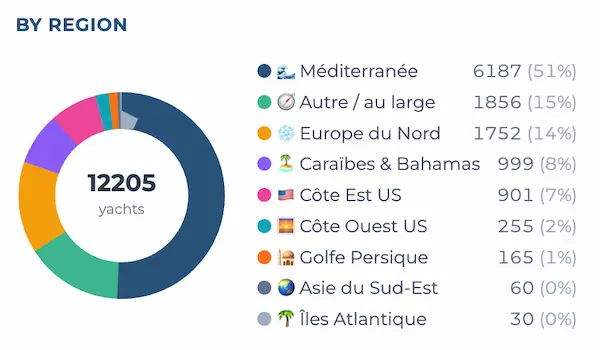
And by region, one basin owns the sport. The Mediterranean alone accounts for 6,187 vessels — 51% of the mapped fleet. Northern Europe follows at 14% (1,752), then the Caribbean & Bahamas (8%) and the US East Coast (7%). Half of the world’s large leisure fleet, in one sea.
Reading the map: every yacht over 18 metres
Plot those Mediterranean yachts and the density is unmistakable. The whole northern basin glows, but the heat concentrates into a few unmistakable hotspots — the French and Italian Riviera, the Balearics, Sardinia, the Aegean and the Turkish coast — with one genuine surprise far to the north that we will come back to.
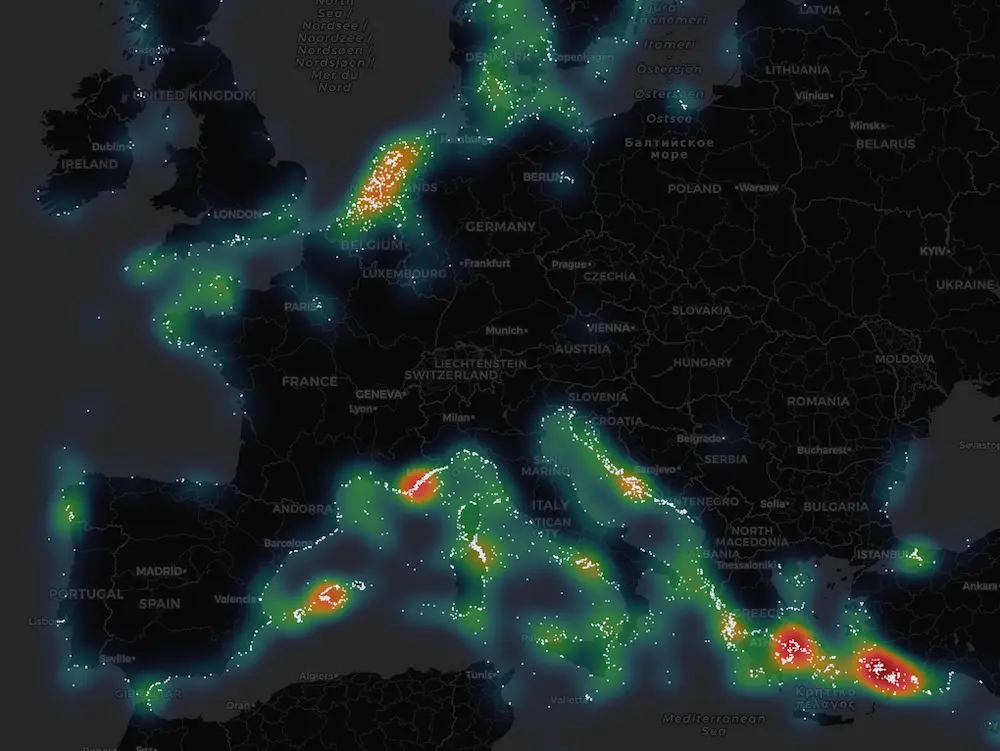
Let’s zoom into the brightest clusters, one by one.
Where do superyachts cluster in the Mediterranean?
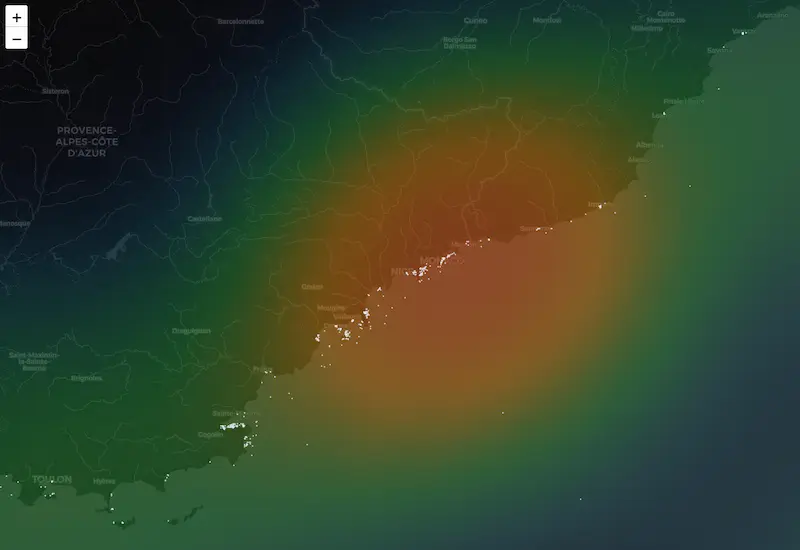
Above all on the French and Italian Riviera. The stretch from Saint-Tropez to Monaco — Cannes, Antibes, Cap Ferrat, Monte-Carlo — packs the marinas, the shows, the shipyards and the owners’ villas within a tender ride of one another. And the data crowns a clear king: Port Hercule in Monaco is the single busiest berth in the whole dataset, and the one with the largest average yacht. More on that below — but the zoom already shows the Riviera burning brighter than anywhere else in the Med.
The Balearics: Palma
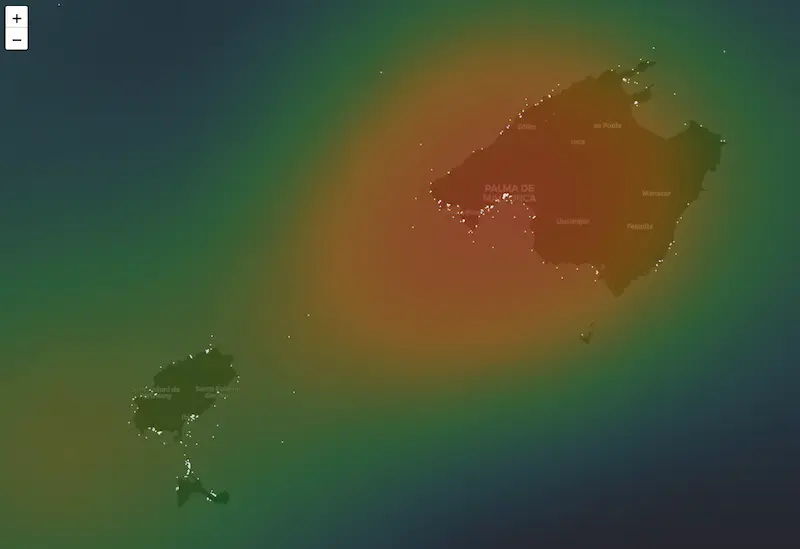
West of the mainland, the Balearics hold their own — and Palma de Mallorca is the anchor. Home to a deep cluster of refit yards, brokers and marinas (Club de Mar among the busiest berths anywhere), Palma is the western Mediterranean’s service capital as much as a cruising base. Just south, tiny Formentera does the opposite job: a pure day-anchorage magnet over turquoise sandbanks.
Sardinia: the Costa Smeralda magnet
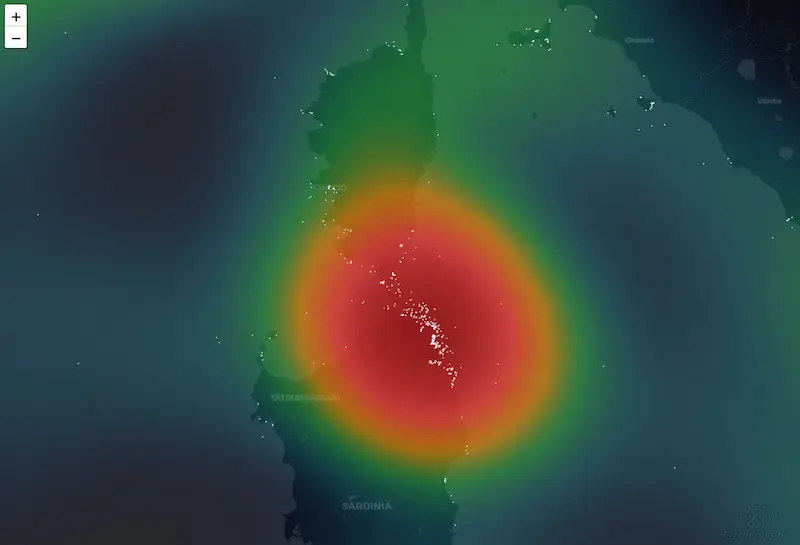
Further east, Sardinia and the Costa Smeralda pull the Italian and international fleet to Porto Cervo — one of the very few places that rivals the Riviera for sheer concentration of large yachts in peak weeks. Hold that thought: when we filter down to the true giants, Sardinia does not just compete. It wins.
The eastern draw: Greece and Turkey
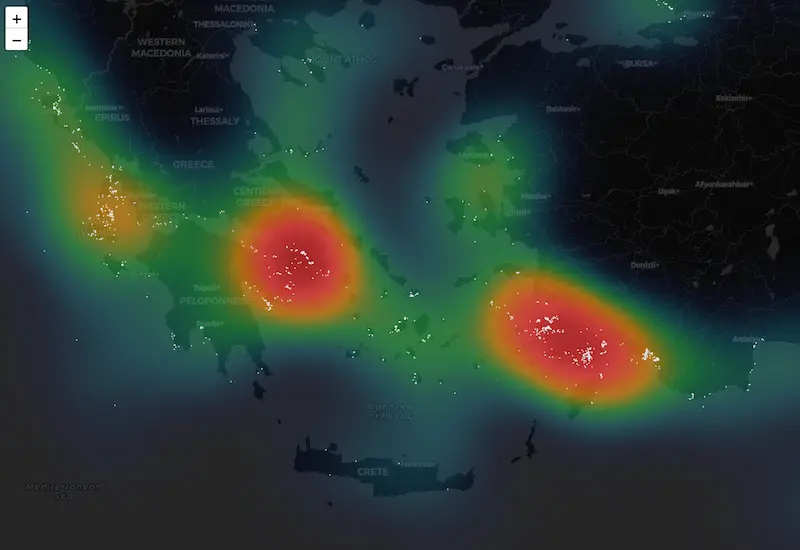
The season no longer ends at the Strait of Messina. Greece now holds a dense, growing share of the fleet — the Athens marinas (Flisvos and Mikrolimano at Piraeus rank among the busiest berths anywhere) act as the gateway, and from there the fleet scatters into the Aegean and Ionian. Reliable wind, sheltered bays and a wilder coastline pull owners east for the second half of summer.
But look at the same zoom and the single most intense bloom sits not in Greece at all — it is on the Turkish coast. The south-west shore around Bodrum, Göcek and Fethiye is one of the densest hotspots on the entire eastern map: Milta Bodrum Marina (69 yachts) and Ece Marina in Fethiye (62) rank among the busiest berths in the whole dataset. The nuance is that Turkey draws volume rather than size — average lengths here sit around 24–26 metres, and 96–98% of the fleet is under 40 metres. This is the heartland of the blue-cruise and charter fleet, not the 60-metre giants (which stay west). Massive in numbers, mid-size in metres.
Is the Netherlands really a superyacht hotspot?
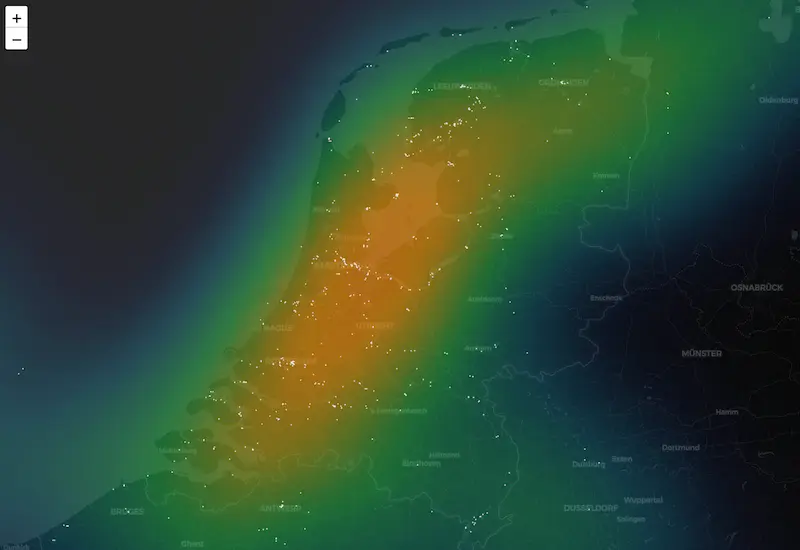
Not quite — and it is the map’s best lesson in reading data. Far from the sun-and-sea logic of the rest of the map, the Netherlands glows brightly, but that glow hides a twist worth telling.
Part of the answer is real superyachting: the Dutch coast is the beating heart of large-yacht construction and refit, where Feadship, Amels, Heesen, Oceanco and Damen build and finish some of the world’s biggest vessels. What looks like a cruising ground is often a birthplace — hulls on sea trials, deliveries, and yachts in for the winter refit.
But look closer at the zoom and something else is going on: the heat does not hug the coast, it drives deep inland — across the Randstad, up the canals and rivers toward the German border. That is the giveaway. A simple "over 18 metres" filter doesn’t only catch superyachts — it catches the Netherlands’ vast inland barge fleet, the commercial péniches that work Europe’s densest network of waterways and are routinely 40, 80, even 100-plus metres long. The lesson: a length filter shows you tonnage, not glamour. Much of the Dutch signal is cargo, not caviar — and knowing the difference is half of reading a map like this honestly.
Which marina is the busiest for superyachts?
Port Hercule in Monaco, by a clear distance. Heat maps show where the fleet drifts; the berth data shows where it actually stops — and ranked by the number of large yachts recorded, one name tops the list on count and on size. Here is the full top 10 for yachts over 18 metres:
| # | Marina | Country | Yachts | Avg | Under 40 m |
|---|---|---|---|---|---|
| 1 | Port Hercule · Monaco | 🇲🇨Monaco | 157 | 41 m | 55% |
| 2 | Club de Mar · Palma | 🇪🇸Spain | 134 | 29 m | 84% |
| 3 | Bahia Mar · Fort Lauderdale | 🇺🇸USA | 134 | 30 m | 82% |
| 4 | Flisvos Marina · Athens | 🇬🇷Greece | 105 | 35 m | 69% |
| 5 | Port Vauban · Antibes | 🇫🇷France | 93 | 36 m | 72% |
| 6 | Fort Lauderdale · New River | 🇺🇸USA | 93 | 32 m | 74% |
| 7 | Mikrolimano · Piraeus | 🇬🇷Greece | 89 | 32 m | 81% |
| 8 | Newport Shipyard · RI | 🇺🇸USA | 85 | 30 m | 82% |
| 9 | Milta Bodrum Marina | 🇹🇷Turkey | 69 | 26 m | 96% |
| 10 | Island Gardens · Miami | 🇺🇸USA | 66 | 26 m | 91% |
The 10 busiest berths for yachts over 18 metres — AIS snapshot, 31 July 2026.
Filter to 40 metres and up and the ranking sharpens into a portrait of pure superyachting. The volume marinas (Palma, Fort Lauderdale) slide down; the Mediterranean prestige ports rise — and Capri posts the largest average of all. The top 10 for 40 m-plus yachts:
| # | Marina | Country | Yachts | Avg |
|---|---|---|---|---|
| 1 | Port Hercule · Monaco | 🇲🇨Monaco | 71 | 60 m |
| 2 | Flisvos Marina · Athens | 🇬🇷Greece | 33 | 51 m |
| 3 | Port Vauban · Antibes | 🇫🇷France | 26 | 60 m |
| 4 | Port de Saint-Tropez | 🇫🇷France | 25 | 50 m |
| 5 | Fort Lauderdale · New River | 🇺🇸USA | 24 | 44 m |
| 6 | Bahia Mar · Fort Lauderdale | 🇺🇸USA | 24 | 46 m |
| 7 | Club de Mar · Palma | 🇪🇸Spain | 22 | 49 m |
| 8 | Marina Grande · Capri | 🇮🇹Italy | 18 | 64 m |
| 9 | Mikrolimano · Piraeus | 🇬🇷Greece | 17 | 51 m |
| 10 | Port Pierre Canto · Cannes | 🇫🇷France | 15 | 49 m |
The 10 busiest berths for yachts over 40 metres — note Capri’s 64 m average (AIS snapshot, 31 July 2026).
The takeaway is clean: the bigger the yacht, the more it concentrates. An 18-metre yacht can be anywhere; a 60-metre yacht is almost certainly in one of a dozen Mediterranean marinas — and quite possibly in Monaco.
Where do 60-metre superyachts gather?
In one place above all: Sardinia. Filter the whole Mediterranean map down to only the true giants — over 60 metres — and the picture turns concentrated and exclusive, pointing squarely at the Costa Smeralda:
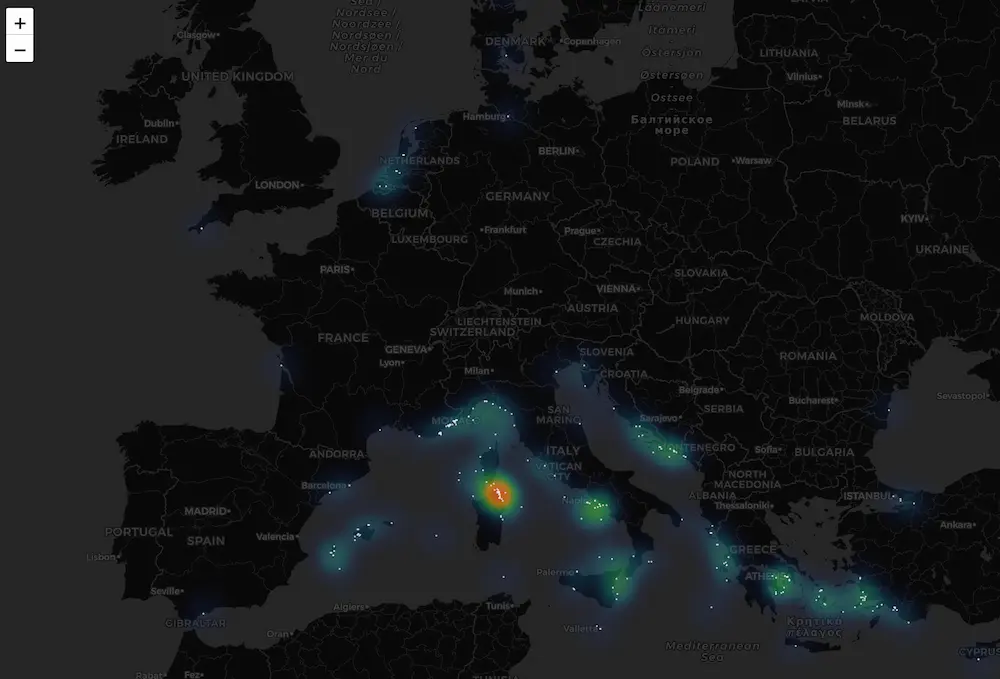
Sardinia is the outright winner. Porto Cervo’s deep-water berths, the Costa Smeralda’s discretion and its central position in the western Mediterranean make it the natural gathering point for the largest vessels afloat. Where the 18-metre map is broad and busy, the 60-metre map is narrow and elite — and it points squarely at the Sardinian coast.
What the map means if you run a yacht
For a captain or a manager, this is more than a pretty picture — it is the operational calendar. The fleet’s geography tells you where berths will be scarce, where suppliers and crew are stretched, where charter demand concentrates, and where yard capacity sits for the winter. And it is the exact view we give our clients every day: at Scyllastar this AIS tracking runs continuously, so every yacht manager sees their own fleet in real time — not once a season, but always.
That live position history is far more than situational awareness — it is the audit trail behind the French commercial diesel exemption. By recording where every charter actually sailed, Scyllastar substantiates the 70% rule that governs the relief; we cover the mechanics in our guide to the French diesel tax exemption for charter yachts. The map is really a by-product of doing the compliance properly.
And that is the point of Scyllastar: the same platform that maps the fleet also runs its financial administration, its charter management, its crew and its planned maintenance — everything a well-run yacht needs, in one place. Wherever the map sends the fleet next summer, the well-organised yacht is the one that arrives ready. Discover Scyllastar.