
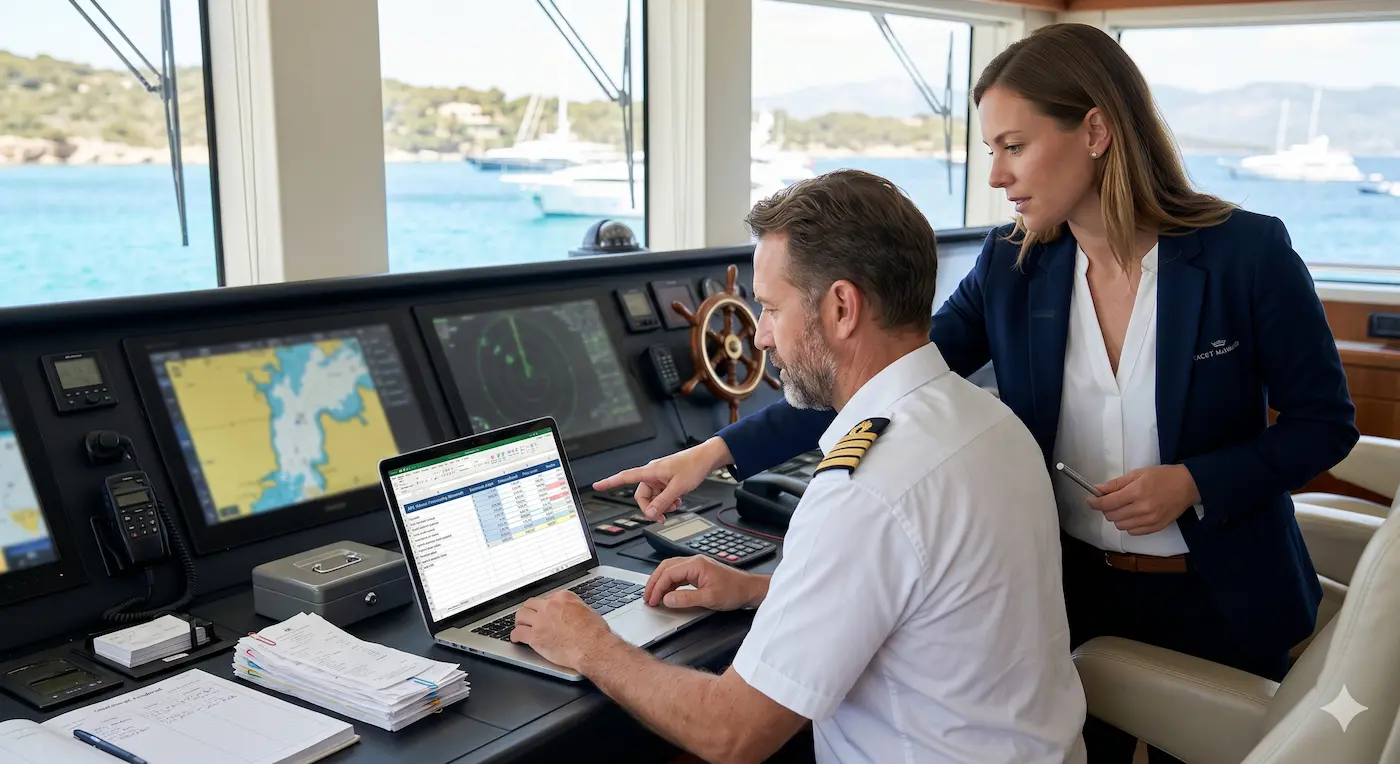
We sat down with Niels Haqueberge, CEO of Scyllastar — the yacht management software — to get a practical, no-nonsense guide to APA management: one of the most misunderstood aspects of professional yacht chartering.
Let’s start from the beginning. What exactly is APA, and why does it exist?
APA stands for Advance Provisioning Allowance. It’s a fund paid by the charterer on top of the base charter fee — designed to cover all running expenses incurred during the charter, the ones that aren’t included in the headline price.
The concept exists for one reason: friction-free luxury. When a family or group steps on board a yacht, they should never have to think about money. They don’t pay at the fuel dock, they don’t settle marina bills at the end of a night, they don’t hand over cash when the chef comes back from the market. Everything is handled by the crew, seamlessly and invisibly. The guests focus entirely on leisure and pleasure. That’s the promise of a professional charter — and the APA is what makes it operationally possible.
How much is the APA, typically?
It varies, and the most important variable is the type of yacht. Sailing superyachts generally set APA at around 20 to 25% of the base charter fee — their fuel consumption is significantly lower, so the fund doesn’t need to be as large. Motor yachts are a different story. Fuel burn is much higher, marinas are often more expensive, and provisioning costs scale accordingly. For a motor yacht, APA typically sits between 30 and 35% of the base charter fee, and can reach 40% or more for larger vessels.
To give you a concrete number: on a €50,000 charter contract for a motor yacht, the charterer might pay €65,000 in total — €50,000 for the base fee and €15,000 for the APA. That €15,000 is what the crew will spend on their behalf during the week.
The APA is usually paid alongside the final charter instalment, often 30 days before embarkation. That timing matters — it gives the captain and chef enough lead time to start provisioning before the guests even step on board.
What exactly does APA cover — and what doesn’t it cover?
The core expenses are always the same: fuel for the yacht, tenders, and generators; food and beverages; port and marina fees; water sports equipment rentals; and any special guest requests made during the charter.
What the APA does not cover: the base crew salary and insurance. Those are fixed costs included in the charter fee itself, not variables that depend on where the yacht goes or what the guests order.
One thing that makes a real difference is the guest preference sheet — a document the charterer fills out before embarkation. It covers dietary preferences, favourite drinks, food allergies, activities, and planned destinations. The more thoroughly this is completed, the more accurately the chef can provision before the charter begins, and the fewer unexpected expenses arise during the week.
Who manages the APA on board day to day, and what does that look like in practice?
The captain is ultimately responsible, but in practice, any crew member with banking delegation can make purchases on behalf of the charterer. These are trusted, senior members of the team — access to APA funds is not something you grant without careful consideration.
The APA is typically loaded onto a dedicated credit card used exclusively for charter expenses. No mixing with personal spending, no exceptions.
Every expense gets logged immediately into a charter management system: the amount, the VAT where applicable, the category, the vendor name, a short description, and a scan of the receipt. Captains who manage APA through dedicated software have all of this automated from day one. Those who use Excel can achieve the same result, but it requires considerably more manual discipline and produces a less professional output at reconciliation.
What happens when the APA starts running low mid-charter?
This is where communication becomes critical — and where roles matter enormously.
The captain’s job on board is to deliver an exceptional guest experience. Having a conversation about money with a charterer mid-trip is not part of that role. So when the APA balance gets low, the captain contacts the yacht manager, and the yacht manager reaches out to the charterer directly to request a top-up. That chain of communication is deliberate.
When a professional charter management system is in use, this situation rarely becomes tense — because the charterer is already informed. Good software shows the running balance after every expense. Guests who can see their APA decreasing in real time are never shocked by a low-balance notification.
If a charterer refuses to top up — which is genuinely rare in well-managed charters — then provisioning stops. No more food gets bought. That’s uncomfortable for everyone, and it almost always results from poor communication earlier in the charter, not a deliberate refusal.
Walk us through the APA Final Statement. What does it actually look like?
The APA Final Statement is the document that closes out the charter. It’s a full, categorized list of every expense charged to the APA, from the first day to the last — with date, amount, VAT, subcategory, vendor, description, and a scan confirmation for each line. At the bottom: the total balance, and signature lines for both the captain and the client.
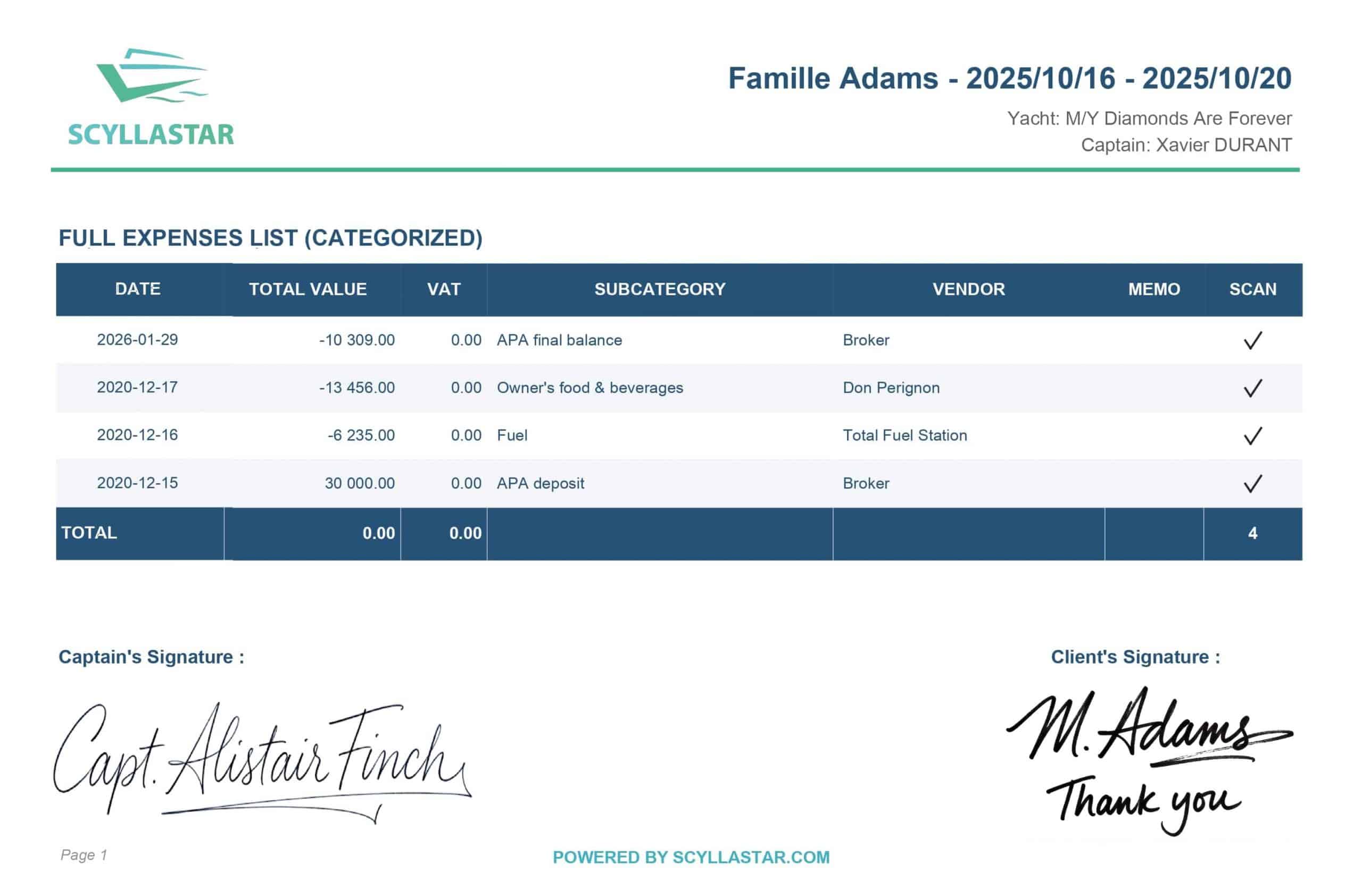
Here’s a real example from a recent one-week Mediterranean charter. The yacht started with a €10,000 APA deposit. By the end of the week, expenses included two port stays in Monaco and Antibes, a berth in Sanremo, over 685 liters of fuel, and multiple food and beverage runs. Seventeen receipts — every one scanned, every one categorized. The remaining balance was returned to the client. Total on the final statement: €0.00. Both parties signed.
That’s what a clean APA Final Statement looks like: two pages, no ambiguity, no disputes.
Under the MYBA framework, accounts must be clearly presented and self-explanatory. If the charterer prefers a bank transfer for their refund rather than cash, that option should always be offered. The captain should also ensure there are no outstanding supplier invoices after the document is signed.
⚓ The golden rule of APA: No surprise at the end of the charter. The charterer signs each individual receipt at the time of the expense — not just the final statement. If the guest signed the receipt when it happened, there is nothing to dispute at closing.
Speaking of disputes — what goes wrong, and what legal framework applies?
Disputes almost always trace back to one thing: an expense the charterer doesn’t recognize or claims not to have authorized. Signed receipts eliminate this almost entirely. But when a disagreement does escalate, the MYBA charter agreement — which governs the vast majority of professional yacht charters in Europe — provides a clear framework.
MYBA contracts are subject to English law. Disputes are resolved through arbitration under LMAA terms (London Maritime Arbitrators Association) — a private, professional process handled by people who understand the charter industry.
Crucially, the MYBA contract places specific obligations on the captain. The captain is answerable directly to the charterer for the disbursement of the APA, must maintain accurate records, provide receipts on request, and present a full statement of accounts before the charterer disembarks. This is a contractual obligation, not optional good practice.
What would you tell a captain managing APA for the very first time?
First: scan every expense immediately. Don’t batch them at the end of the day. Don’t leave them for tomorrow morning. If you allow a backlog to build, you lose visibility over your remaining balance — and you may discover too late that the APA is already negative. That damages your credibility as a captain and puts you in an impossible position with both the charterer and the yacht manager.
Second: use a dedicated tool. You did not spend years building a career as a yacht captain in order to do accounting on board. That is not your job, and it should not be your stress. A proper charter management system handles the tracking, the categorization, the receipt management, and the APA Final Statement automatically — so you can stay focused entirely on the charterer experience, which is what you are actually there to deliver.
What tools do you recommend, and where does someone start if they have no budget?
Scyllastar’s yacht charter software is built for exactly this — it automates the full APA lifecycle, from the first expense to the signed APA Final Statement.
Yet not every captain or management company is ready to commit to software immediately. That’s why we offer a free Excel template specifically built for charter billing and APA management. It’s structured, it covers all the right categories, and it will keep you organised if you use it with discipline. It’s a legitimate starting point — and it’s free.
If you’re managing a single yacht and doing occasional charters, the Excel template gets the job done. If you’re managing multiple yachts or working within a professional management company, the switch to dedicated software pays for itself quickly — in time saved, in errors avoided, and in the quality of the APA Final Statements you hand to your charterers.
Any final advice for captains and managers who want to get this right?
Don’t set the APA and forget it. Too many charters start with an APA amount chosen by habit — 25%, because that’s what was done last season — without any thought given to the actual itinerary. If you’re planning a route with significant fuel legs and multiple premium marinas, model the costs before the charter starts. A rough estimate of expected fuel consumption, berthing fees, and provisioning goes a long way toward setting an APA that actually covers the week.
And communicate. Charterers who are kept informed — who see their balance, who understand what was spent and why — are charterers who trust you. That trust is what produces a signed APA Final Statement, a tip for the crew, and a returning client the following season.
Interview conducted with Niels Haqueberge, CEO of Scyllastar — the yacht management software built for captains, yacht managers, and fleet operators.